
Research & Benchmark Water Damage
Who Wins Local Water Damage Searches: A Benchmark of 27 Searches
A homeowner with water on the basement floor types "water damage restoration" and the name of their city into Google. Who do they see? Often, not a restoration company at all. We analyzed 27 local searches across 9 US metros and three water damage search types, 254 restoration company websites (232 crawled) and 287 Google Business Profiles, November 2026. The data was collected on November 16 and 17, 2026, inside frozen-pipe season in the northern study metros (New York, Chicago and Boise). It is one snapshot, and nationally these searches peak in summer, not winter. This page is about search: who holds page one, the map pack and the ad slots. If you came for market size, insurance claims or water damage statistics for homeowners, this isn't that report.
The restoration industry statistics pages that rank today are roundups of other people’s numbers: market size, growth forecasts, claim counts. None of the ones we read looked at the results page a homeowner actually sees. For a restoration owner that page is the market. If you know who holds its spots, you know who you’re really up against, and which parts of it are realistic to win.
Key findings
- Fewer than half of page one is restoration companies. 49% of page-one organic results (115 of 235) went to restoration companies’ own websites. The rest went to directories (56), social sites (31), lead-generation sites (20), city-named doorway pages (8) and government or media pages (5).
- The top spot often goes to someone else. A site that is not a restoration company held the #1 organic spot in 13 of 27 searches, and 56% of all top-3 organic spots (45 of 81).
- Lead sellers are on page one. Lead sellers and doorway pages took 12% of page-one organic results (28 of 235) and appeared in 16 of 27 searches, HomeAdvisor alone 13 times.
- Map pack and organic are different races. Only 13% of map-pack restoration companies with a website (10 of 78) also ranked on page one organically for the same search.
- Franchise brands are a big share of Maps. 32% of Maps rows (173 of 534) belonged to franchise brands and another 4% to company-owned chains. SERVPRO alone was 85 rows, in all 9 metros.
- A map pack on every search. A map pack appeared on all 27 searches, an AI Overview on 13, Local Services Ads on 4 and text ads on 6.
Who holds page one
Across the 27 searches we recorded 235 organic results on page one. Fewer than half of them, 49% (115 of 235), went to restoration companies’ own websites. The rest went to directories (56), social sites (31), lead-generation sites (20), city-named doorway pages (8) and government or media pages (5).
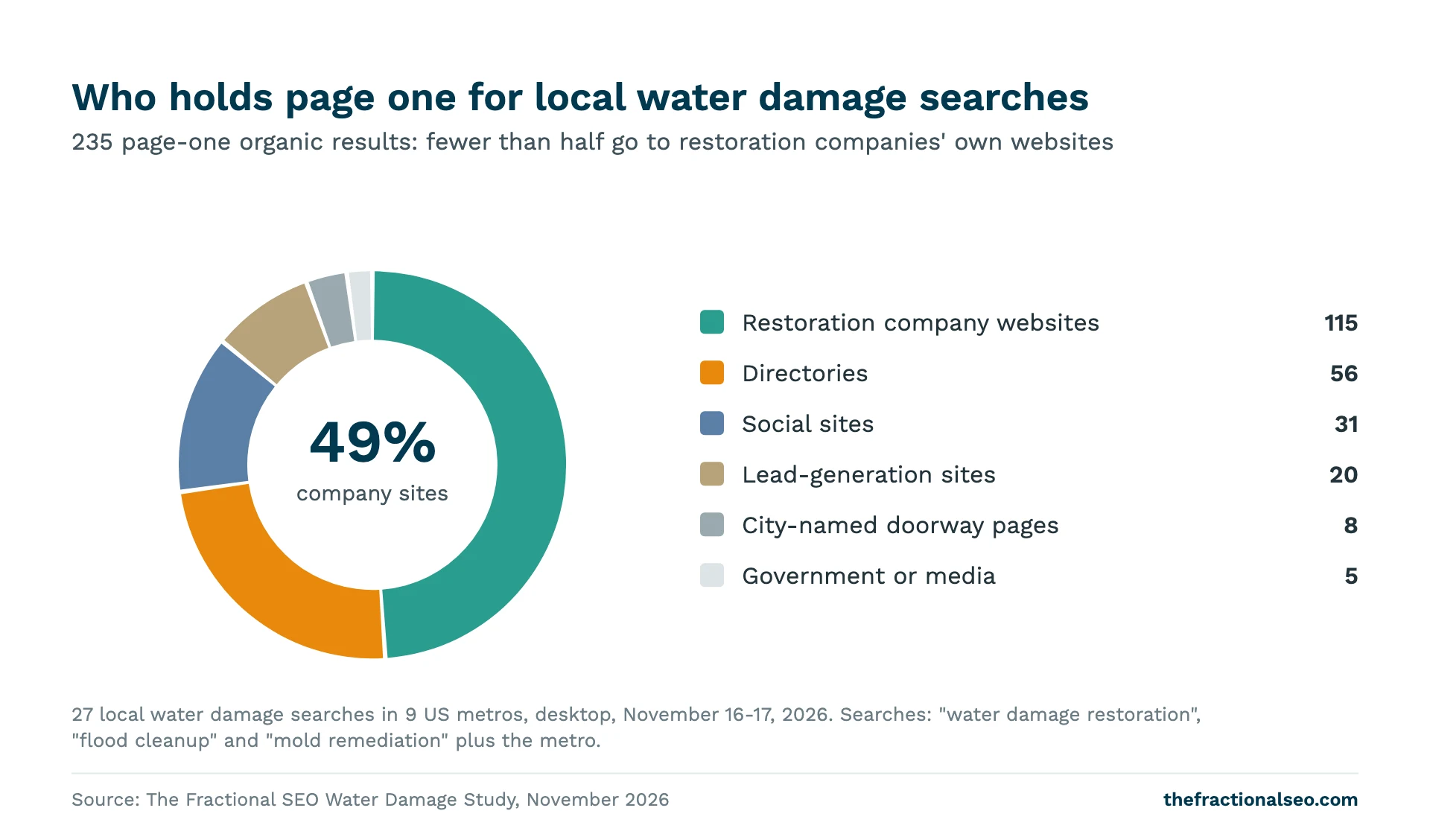
The very top of the page is no friendlier. A site that is not a restoration company held the #1 organic spot in 13 of 27 local water damage searches, and 56% of all top-3 organic spots (45 of 81). In those searches, the first organic result a homeowner sees is not a restoration company: a directory, social page, lead seller, doorway page or government or media page.
The study shows who appears, not why. Our reading is that many people searching in an emergency want to compare several companies fast, and a list does that in one click. For a restoration company, it means some page-one spots aren’t realistically yours. The realistic ones are the remaining organic positions and the map pack.
Directories and social sites
Yelp is the directory restoration companies meet most on page one: 33 appearances in 27 searches, far ahead of bbb.org (5) and mapquest.com (4). Facebook appeared 23 times. Angi and HomeAdvisor show up too, but we classed them as lead-generation sites, not directories (more on those below).
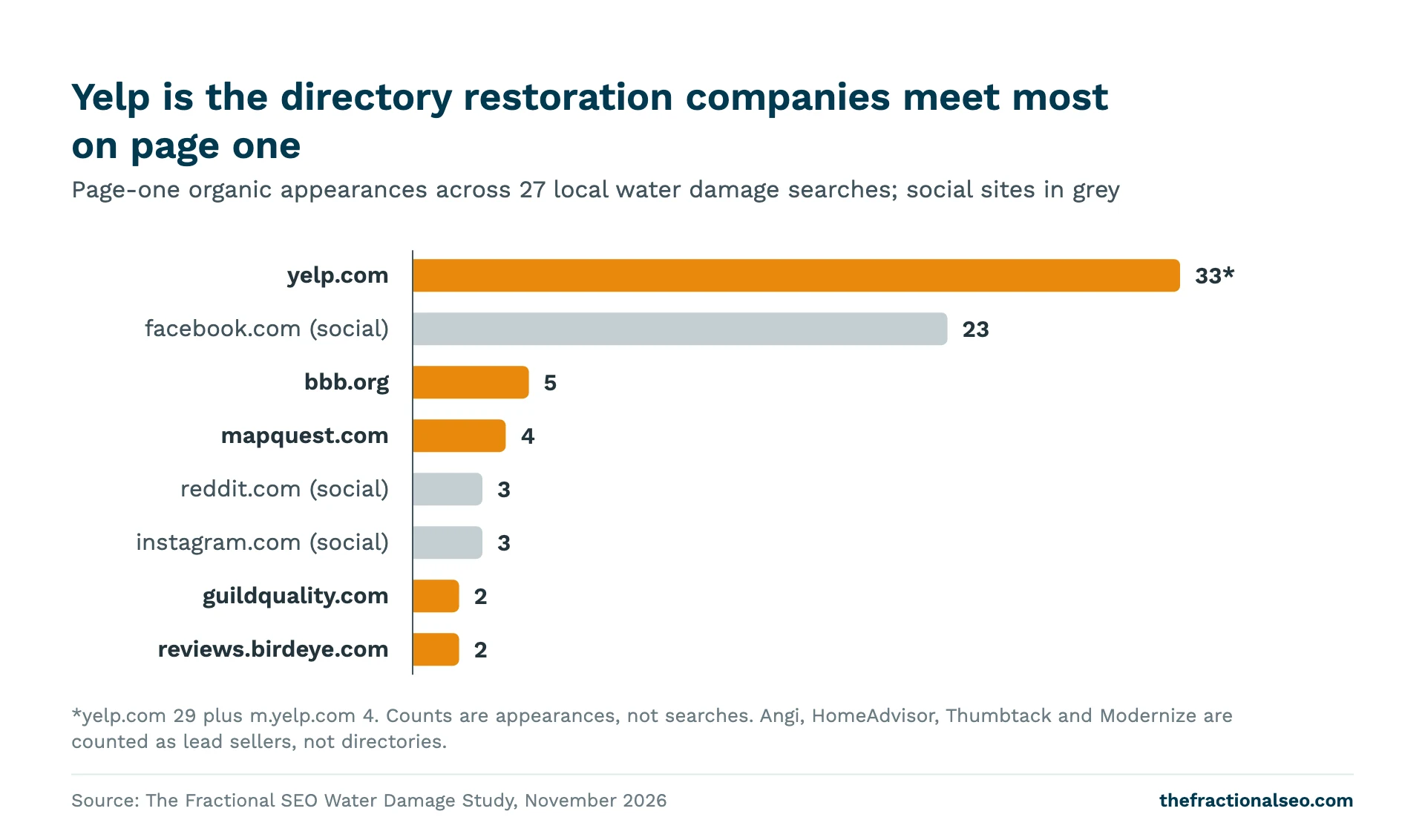
The counts are appearances, not searches: one search can show Yelp twice. For how to use these listings without paying for leads you can’t measure, see directories and lead sellers in water damage search.
Lead sellers and doorway pages
This is the part of the page that stands out in water damage. Lead sellers and doorway pages take 12% of page-one organic results (28 of 235) and appear in 16 of 27 searches: homeadvisor.com alone 13 times, plus angi.com (3), modernize.com (2) and 8 city-named pages on free hosts (pages.dev, Weebly, Wikidot and look-alike city subdomains).
A doorway page here is a thin page built around one city and one service, often on a free website host. Google’s spam policies describe doorway abuse as “when sites or pages are created to rank for specific, similar search queries” (Google Search Central). We counted only pages the hand-check could show were lead sellers. Pay-per-call networks often run behind ordinary-looking local sites, so 28 is a floor.
Maps is a different story. Lead-generation listings were rare there: 6 of 540 Maps rows, none in a map pack. On this snapshot, the lead sellers competed for the organic results, not the map pack.
| Search | Lead-seller and doorway results on page one |
|---|---|
| Water damage restoration | 13 of 79 |
| Flood cleanup | 8 of 80 |
| Mold remediation | 7 of 76 |
By search and market size
We ran three kinds of search in every metro. Restoration companies’ share of page one differs by search: “water damage restoration” 33%; “flood cleanup” 54%; “mold remediation” 61%. The broadest search, water damage restoration, is the most crowded by directories, lead sellers and doorway pages.
| Group | Restoration company results | Share of page one |
|---|---|---|
| Water damage restoration | 26/79 | 33% |
| Flood cleanup | 43/80 | 54% |
| Mold remediation | 46/76 | 61% |
| Large metros | 54/105 | 51% |
| Mid-size metros | 36/78 | 46% |
| Small metros | 25/52 | 48% |
These are groups of 9 searches per wording, so read them as a description, not a tested difference.
Demand differs by wording too. Monthly searches for one metro’s exact wording (median across the 9 metros): “mold remediation <city>” 720, “water damage restoration <city>” 480, “flood cleanup <city>” 20. People rarely search “flood cleanup” with a city name. Those counts cover one wording each. “Near me” and other variants add more.
Map pack and organic are two different races
The map pack and the organic results are mostly different businesses. Only 13% of map-pack restoration companies with a website (10 of 78) also rank on page one organically for the same search. Nearly every map-pack business shows a website, though: 3 of 81 map-pack listings had no website link.
That fits how Google describes local results: “mainly based on relevance, distance, and popularity”, with prominence meaning “how well-known a business is” (Google Business Profile Help). Our reading: the map pack leans on the profile and the searcher’s location, the organic list leans more on the website, so a company can be strong in one and missing from the other. Our guide to local SEO for water damage restoration companies covers both halves, and our study of what 287 Business Profiles show about reviews covers the profile side.
Franchises, company chains and independents
Water damage is a franchise-heavy trade, and it shows in Maps. We sorted every listing into three groups. A franchise is a location of a franchise brand. A company chain is one brand operating locations in more than one metro, unless its own pages say a location is franchised. Everyone else is independent, including members of networks of separately owned firms.
Franchise locations make up about a third of the Google Maps results for water damage searches: 32% of Maps rows (173 of 534) belong to franchise brands and another 4% to company-owned chains. SERVPRO alone is 85 rows and appears in all 9 metros; PuroClean is next with 19, then 911 Restoration and RestoPros with 9 each. Counted as distinct listings rather than rows, franchises are 84 of 287 (29%), company chains 14 (5%) and independents 189 (66%). The franchise share of rows was 28% in large metros, 40% in mid-size metros and 29% in small ones.
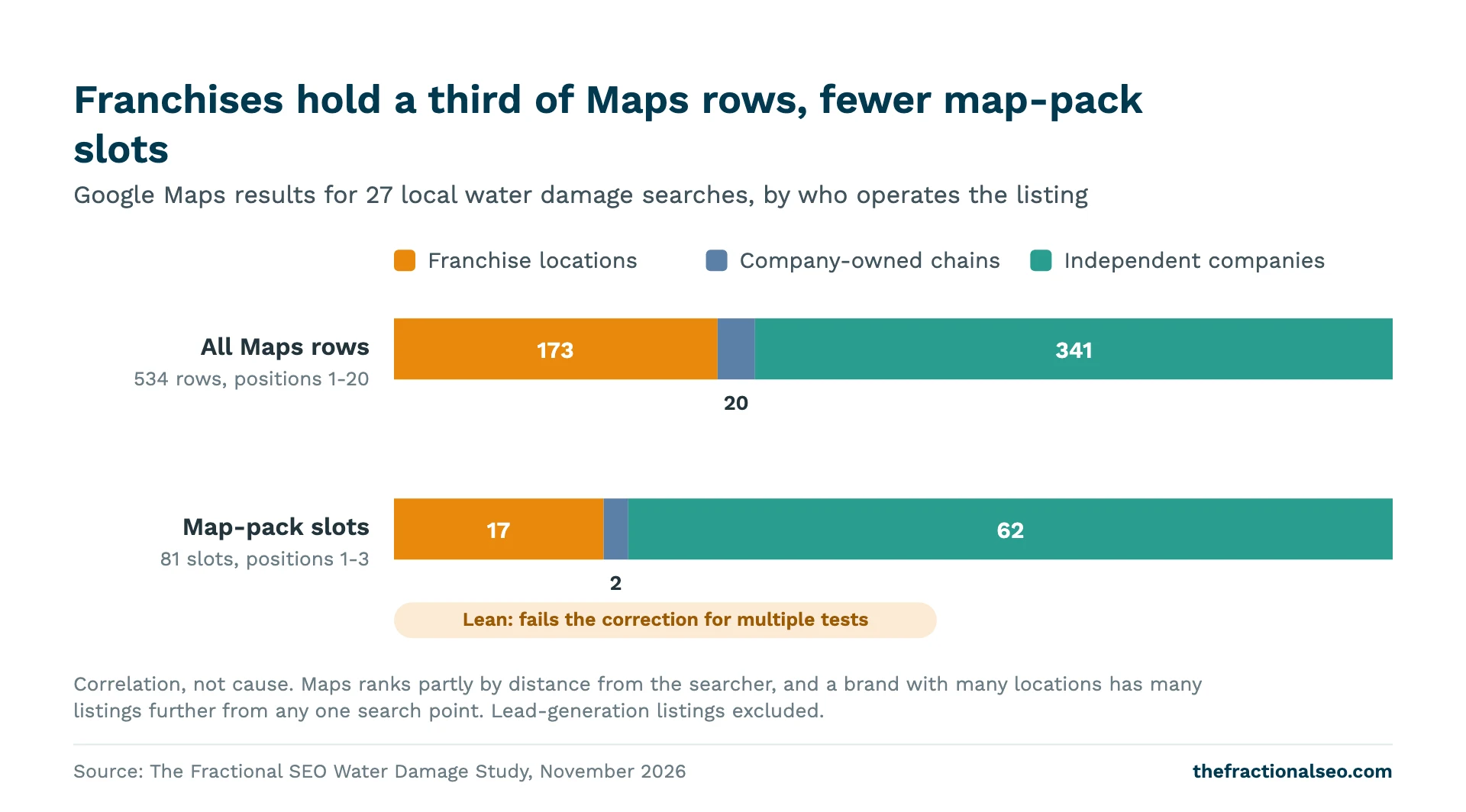
In the map pack itself the picture shifts a little. Franchises held 21% of map-pack slots (17 of 81) against 34% of positions 4-20, and independents held 77% of map-pack slots. That gap is too small to rule out chance in a sample this size, so treat it as a lean, not a result. There is also a simple reason it could appear: Maps ranks partly by distance, and a brand with many locations has many listings further from any one search point.
Franchise listings do carry more Google reviews than independents: a median of 102 vs 64 across all Maps rows, and 227 vs 84 among map-pack rows. The first gap is clear; the map-pack one rests on 17 franchise rows and is not. These are rows, not businesses: a listing that shows in several searches counts each time.
One more pattern. Keyword-named Maps listings with few reviews (a name made only of city and service words, such as “<city> Water Damage Restoration”) showed up 28 times in the Maps results and held 4 of 81 map-pack spots. That is a rule-based flag, not proof a listing is fake, and we don’t name them.
Ads, AI Overviews and what a click costs
A map pack appeared on all 27 local water damage searches, an AI Overview on 48% (13), Google Local Services Ads on 15% (4) and text ads on 22% (6). No text ad appeared above the organic results in this snapshot.
| Shown on the page | Water damage restoration | Flood cleanup | Mold remediation |
|---|---|---|---|
| Local Services Ads | 0 of 9 | 2 of 9 | 2 of 9 |
| Text ads (anywhere) | 2 of 9 | 2 of 9 | 2 of 9 |
| AI Overview | 4 of 9 | 3 of 9 | 6 of 9 |
Read the ad numbers with care. This is one desktop snapshot per search, taken in November, while national interest in water damage searches peaks in August, and ads rotate by time, device and user. Google lists water damage restoration as a Local Services Ads category, where you pay for leads, not clicks (Google Local Services Ads; Google Ads Help). Few sites show ad traffic in third-party data: only 7 of 254 water damage websites (3%) show any estimated Google Ads search traffic in DataForSEO, while a Google Ads tag is visible on 15% of homepages. That source misses most local and Local Services ads, so don’t use it to count advertisers. Clicks that are bought aren’t cheap. The median Google Ads cost per click is $34.17 for “water damage restoration <city>” and $33.57 for “mold remediation <city>” (all 9 metros). “Flood cleanup <city>” has a CPC in only 2 metros, up to $221.73 in New York on about 30 searches a month. These are planner bids; real auction prices move. We plan to check the ads again in April 2027.
Traffic benchmarks
How much search traffic does a restoration website get? Less than most owners expect. The median water damage company website gets an estimated 23 organic visits a month; 70% get fewer than 100. Companies that rank both in Maps and organically are the exception (median 254) next to Maps-only (23) and organic-only (14) companies.
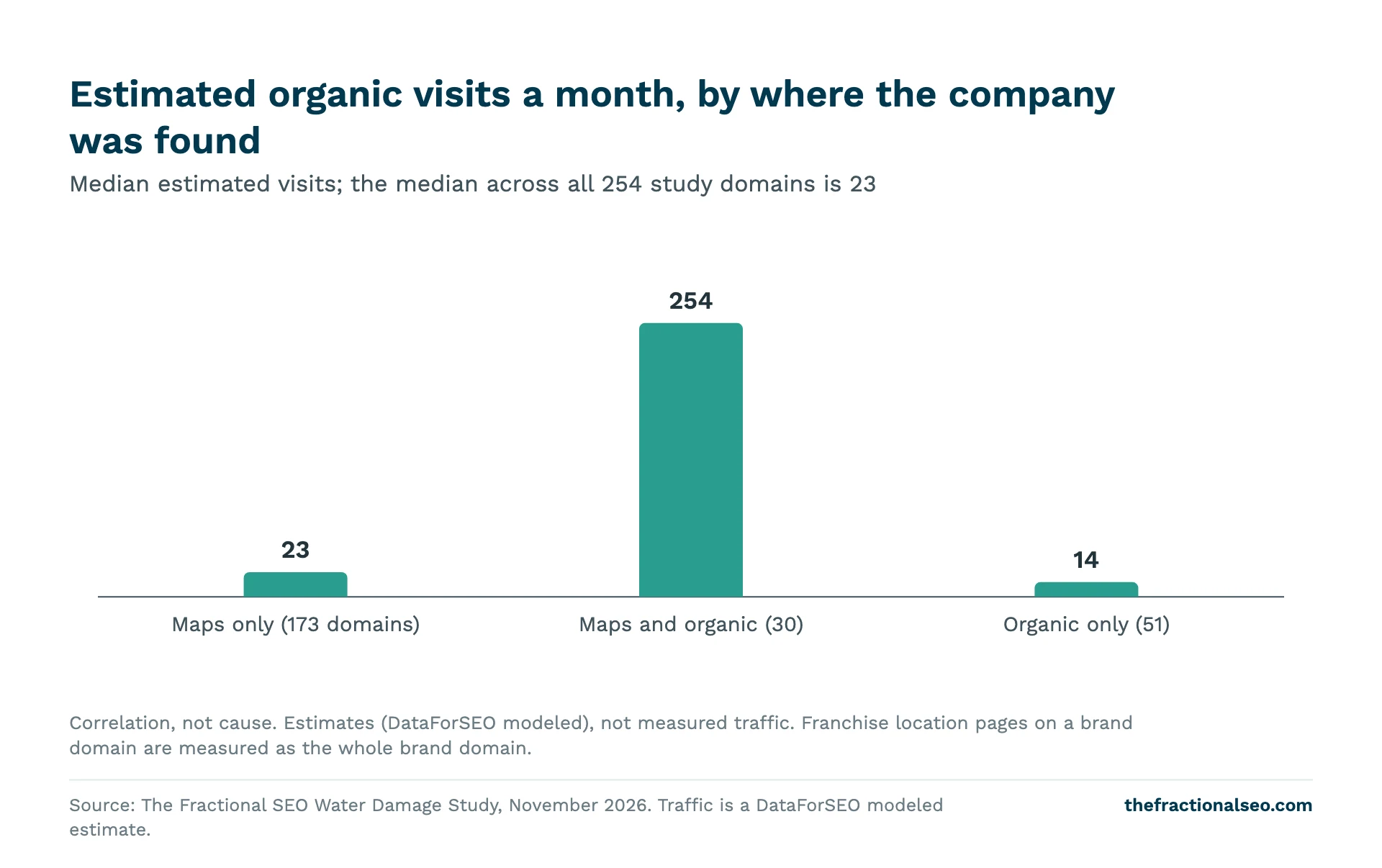
These are estimates from DataForSEO’s traffic model, not measured visits, and franchise location pages on a brand domain are measured as the whole brand domain. Use them to compare sites with each other, not to judge your own analytics.
What this means for restoration companies
The study describes who appears. It doesn’t prove what makes anyone rank. With that caution, here’s how we read it.
- Your competition includes lead sellers. On the broadest search, only 33% of page one (26 of 79) went to restoration companies. A homeowner who clicks HomeAdvisor may still reach you, if you’re there. See our directories and lead sellers page.
- The map pack and organic results are separate jobs. Only 13% of map-pack companies with a website were also on organic page one for the same search.
- Franchises are many, not unbeatable. They are 32% of Maps rows. In the map pack they held 21% of slots vs 34% of positions 4-20, a lean that fails the correction for multiple tests.
- Look at your website too. Our flagship study covers the website gaps most restoration companies leave open.
How we did this
We analyzed 27 local searches across 9 US metros and three water damage search types, 254 restoration company websites (232 crawled) and 287 Google Business Profiles, November 2026.
Searches were “water damage restoration”, “flood cleanup” and “mold remediation”, each followed by a metro name, in 9 metros: New York, Los Angeles, Chicago, Dallas (large); Charlotte, Nashville, Austin (mid-size); Boise, Knoxville (small). Page one only, desktop, SerpAPI. The data was collected on November 16 and 17, 2026, inside frozen-pipe season in the northern study metros. The map pack is positions 1-3 of the Google Maps list for the same search.
Samples: 235 organic results across 27 searches; 56 directory results; 81 map-pack listings, 78 with a website; 534 Maps rows with lead generation excluded and 287 distinct listings (franchises); 81 map-pack vs 453 position 4-20 rows; 254 study domains (traffic). Franchise brands come from brand pages read on November 17, 2026. Traffic is DataForSEO Labs’ modeled estimate. Click costs are Google Ads planner bids.
What it can’t claim: one snapshot per search, so it shows who appeared, not why. 27 searches give 81 map-pack slots, so only large gaps can show up as significant, and “no clear difference” is weak evidence of no effect. Ads rotate by time, device and user, and organic page one moves from day to day, which is why we report shares and medians, never one company’s position.
Questions, answered
Why do directories and lead sellers rank for water damage searches?
We measured who ranks, not why. Restoration companies’ own websites held 49% of page-one organic results (115 of 235); the rest went to directories, social sites, lead sellers, doorway pages and government or media pages. Google says prominence rests partly on links and reviews, and big platforms have plenty of both.
Is the map pack the same as the organic results?
Mostly not. Only 13% of map-pack restoration companies with a website also ranked on organic page one for the same search.
Do franchises like SERVPRO dominate local water damage search?
They are about a third of Maps rows, with SERVPRO in all 9 metros. In the map pack their share was lower, 21% against 34% further down, but that gap is a lean, not a result.
How often do Local Services Ads show on water damage searches?
On 4 of our 27 searches, in one November snapshot. Ads rotate, so check your own market.
How much organic traffic does a typical restoration website get?
An estimated 23 visits a month at the median, and 70% get fewer than 100. These are modeled estimates, not measured visits.
Where do you sit in your market?
Want to know where your company sits against these benchmarks in your own market? See how we approach SEO for water damage restoration companies.
More research & benchmarks
The whole Water Damage library- Google Reviews and Water Damage Rankings: What 287 Business Profiles Show Which parts of a water damage company's Google review profile lean with the map pack, and…
- We Analyzed 232 Water Damage Restoration Websites: The Gaps They Leave Open Eight website gaps common on water damage restoration sites, how often each occurs, and why none…