
Guide Water Damage
Local SEO for Water Damage Restoration Companies
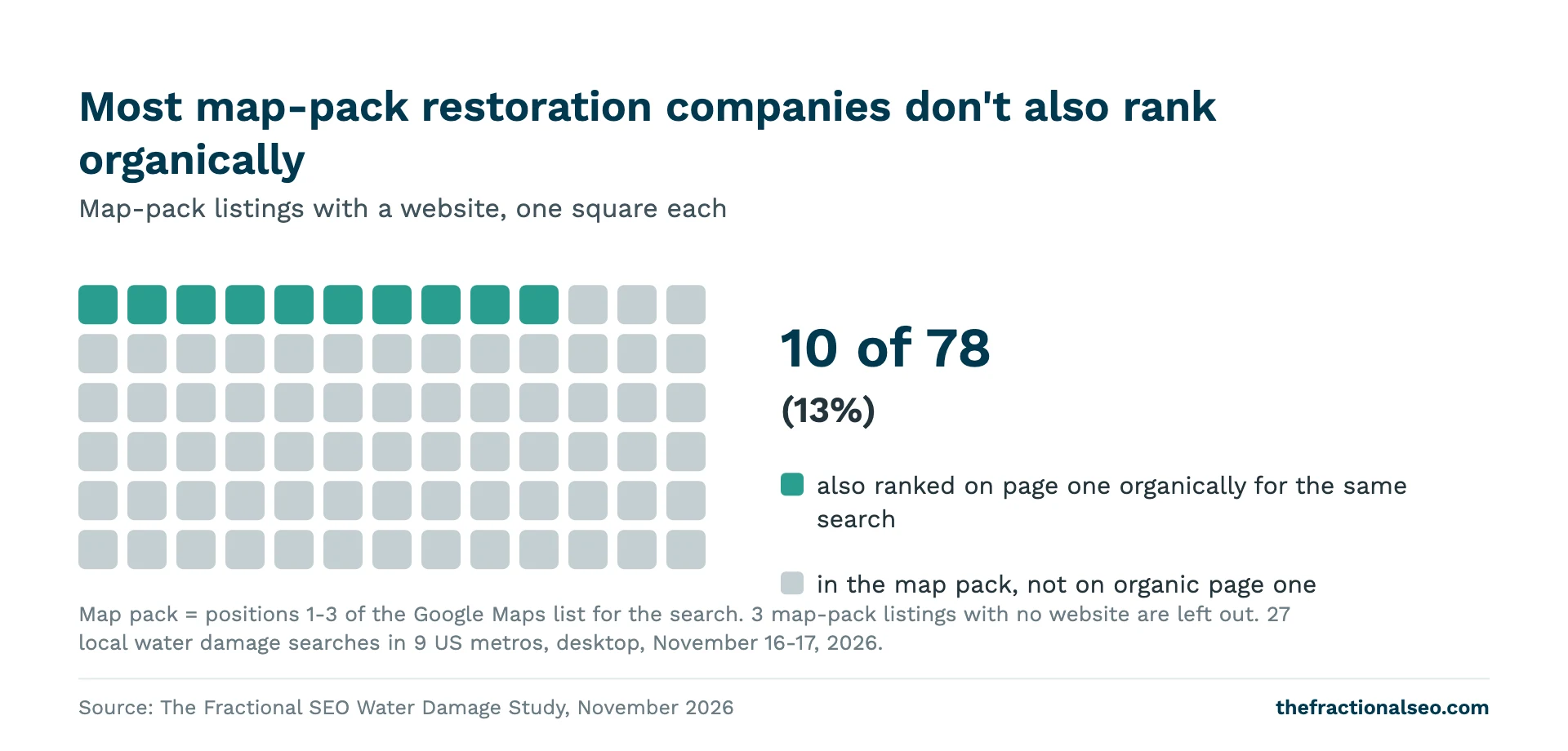
Local SEO for a water damage restoration company is two jobs, not one. The first is the map pack: the Google Maps listings near the top of a search like "water damage restoration" plus your city. The second is the organic results below it. Different companies tend to win each. In our study, only 13% of map-pack restoration companies with a website (10 of 78) also ranked on page one organically for the same search. We analyzed 27 local searches across 9 US metros and three water damage search types, 254 restoration company websites (232 crawled) and 287 Google Business Profiles, November 2026. The data was collected on November 16 and 17, 2026, inside frozen-pipe season in the northern study metros (New York, Chicago and Boise), so read it as one snapshot.
The short answer
- Two jobs: the map pack and the organic results are mostly different businesses. Plan each one separately.
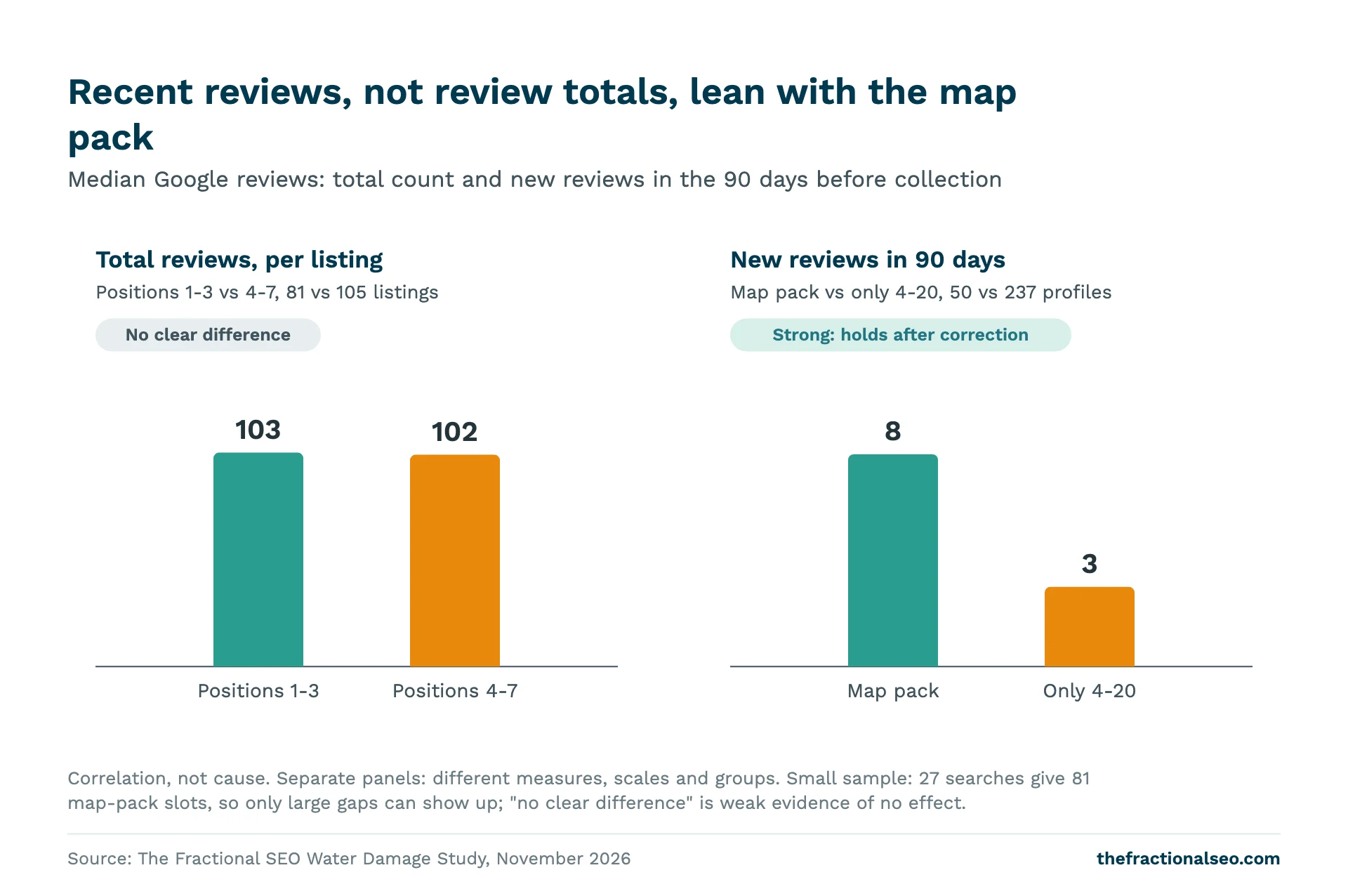
- Map pack: review totals didn’t separate the map pack in our sample (median 103 vs 102, map pack vs positions 4-7). Recent reviews did: a median of 8 new Google reviews in 90 days for map-pack businesses vs 3 for the rest.
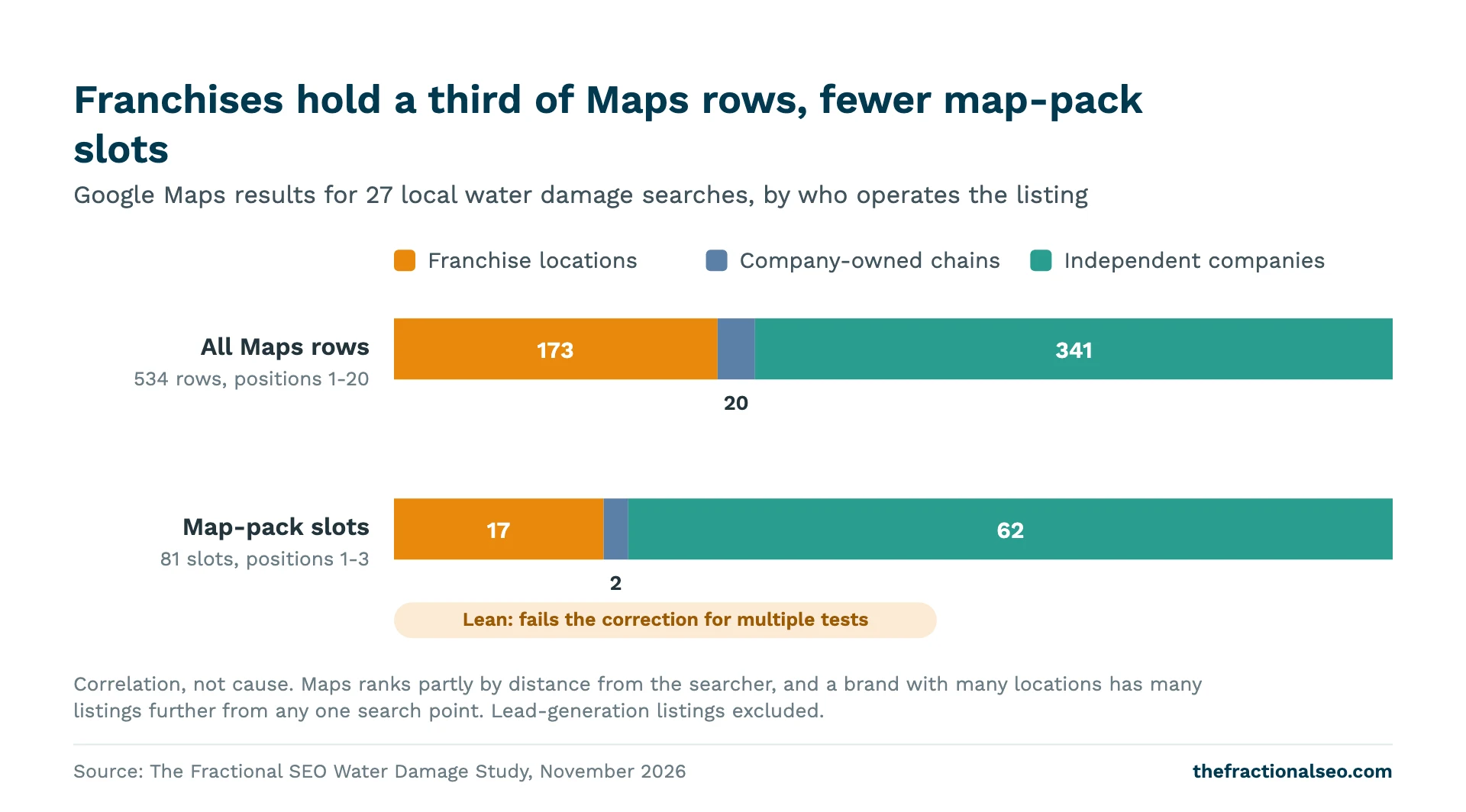
- Franchises: 32% of Maps rows belong to franchise brands. They held 21% of map-pack slots vs 34% of positions 4-20, a lean that fails the correction for multiple tests.
- Website: no website feature separated top-ranked companies from the rest. Location pages and a city in the title tag are common basics, not proven edges.
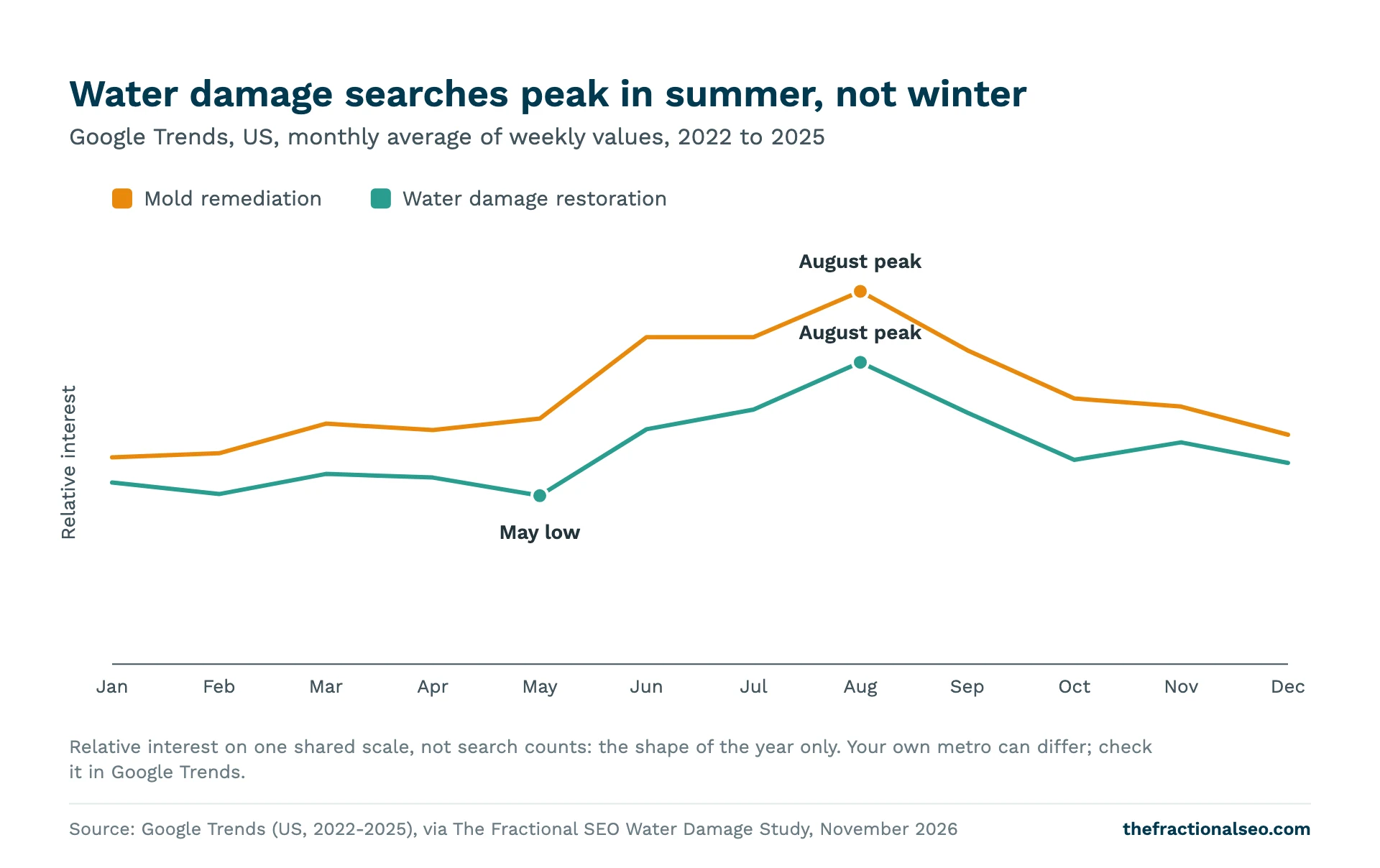
- Seasons: nationally, water damage searches peak in August, not winter. Plan for both.
Where we compare higher- and lower-ranked companies, the results show what tends to go together, not what causes a ranking. The website results are in our study of 232 restoration company websites, and the full results page is in our benchmark of 27 local water damage searches.
What a local water damage results page looks like
Search “water damage restoration” or “mold remediation” with a city name and Google shows two blocks. The map pack sits near the top: a map and three or four businesses with star ratings and a call button. In this guide, “map pack” means positions 1-3 of the Google Maps list for the search. Below it are the organic results, the web pages Google ranks with its normal search algorithm.
They reward different companies. Of the map-pack restoration companies that had a website, only 13% (10 of 78) also ranked on page one organically for the same search.
The organic half is also crowded. Fewer than half of page-one organic results went to restoration companies’ own websites: 49% (115 of 235). The rest went to directories (56), social sites (31), lead-generation sites (20), city-named doorway pages (8) and government or media pages (5). A map pack appeared on all 27 searches, so Maps is never optional in this trade.
How Google ranks local results
Google says local results are “mainly based on relevance, distance, and popularity” (Google Business Profile Help). Relevance is how well your profile matches the search. Prominence, which Google ties to links and reviews, is how well known you are. Distance is how far you are from the person searching, and you can’t change it.
That last one matters for how you check your rankings. A restoration company can sit first in Maps for searches from its own street and not appear two towns over. Check from the neighborhoods your calls come from, not from your office. And Google is plain that “There’s no way to request or pay for a better local ranking on Google.”
Part 1: The map pack
Set up the profile
Start with the category. “Water damage restoration service” is the primary category on 47 of 50 map-pack profiles and 255 of 287 profiles overall. If yours says something else, that’s the first thing to check. Mold searches are a little different: they also surface home inspectors (10) and environmental consultants (8), so a mold remediation page on your site and the right extra category on your profile both matter if mold is real work for you.
The rest of the profile is table stakes. 99% of the profiles are claimed (284 of 287), and a description (96% vs 97%), a website link (94% vs 96%) and extra categories (median 3 vs 3) are near-universal in and out of the map pack. Do them all, but don’t expect any one of them to lift you past a competitor who has them too.
Two rules from Google’s guidelines to keep you out of trouble. “Choose the fewest number of categories it takes to describe your overall core business.” And use your real-world name: “Including unnecessary information in your business name isn’t permitted, and could result in the suspension of your Business Profile” (Google Business Profile Help). Adding “Water Damage & Mold” and a city to a name that doesn’t carry them on your trucks is the classic way to lose a profile. Our Google Business Profile checklist for water damage companies goes item by item.
Reviews: recency over totals
In HVAC, map-pack businesses had far more reviews. Not here. Unlike HVAC, review counts do not separate the map pack from the next places down: map-pack water damage listings have a median of 103 Google reviews vs 102 at positions 4-7. Our sample is small, 81 map-pack slots, so that is weak evidence that totals don’t matter, not proof.
What did separate them was recent reviews. Recent reviews are the clearest profile signal: map-pack water damage businesses got a median of 8 new Google reviews in the 90 days before collection vs 3 for the rest. The 30-day version (2 vs 1) points the same way but fails the correction for multiple tests. This is a correlation: busier companies may simply do more jobs and so get more reviews.
The practical answer is a steady habit, not a one-off push. Ask every customer when the job closes, by text or email, with your Google review link or QR code. Google suggests asking customers to visit a Google review link or scan a QR code (Tips to get more reviews). Ask everyone, not only the happy ones, and never offer anything for a review: Google’s policy bans “incentives – such as payment, discounts, free goods and/or services” (Maps content policy). Our view: the best moment to ask may be when the drying is signed off. More detail is in what 287 Business Profiles show about reviews.
Competing with franchise locations
Franchise locations make up about a third of the Google Maps results for water damage searches: 32% of Maps rows (173 of 534) belong to franchise brands and another 4% to company-owned chains. SERVPRO alone is 85 rows and appears in all 9 metros; PuroClean is next with 19.
The map pack itself looked less one-sided. Franchises hold 21% of map-pack slots (17 of 81) vs 34% of positions 4-20, and independent companies hold 77% of map-pack slots. Treat that as a lean, not a result: the gap is too small to rule out chance in a sample this size. There is also a possible reason it could appear: Maps ranks partly by distance, and a brand with many locations has many listings further away from any one search point.
So what can an independent do? Our view, not a study finding:
- Compete where you are. Distance is the one factor nobody can buy. Make sure your service area, address and pages describe the towns you actually reach fastest.
- Win the recency race. A franchise location carries a national name. You can still out-ask it for reviews this month.
- Be local in writing. Your pages can name the neighborhoods, building types and water problems you see every week, in your own words.
- Don’t stuff your business name. A keyword-stuffed name is a suspension risk, not a shortcut.
Part 2: Local organic results
Here is the honest headline: no website feature separates top-ranked water damage companies from the rest once the number of tests is taken into account (map pack 1-3 vs Maps 4-20; organic 1-3 vs 4-10). With a small sample, that’s weak evidence of no effect, not proof that websites don’t matter. It does mean nobody can honestly sell you one website feature as the thing that will rank you.
Location and service-in-city pages
67% of water damage company websites have location pages or service-in-city pages; among those that do, the median is 14.5 such pages. They’re common. In our comparisons they showed no reliable difference: 59% vs 68% (map pack vs lower in Maps) and 63% vs 81% (organic top 3 vs 4-10).
Build them for the towns you really serve, with something true and specific on each: response area, the kinds of homes and buildings there, the water problems you see. Avoid the other kind. Our searches turned up 8 city-named doorway pages on free hosts, and Google’s spam policies define doorway abuse as “when sites or pages are created to rank for specific, similar search queries” (Google Search Central). Fifty near-identical city pages are a risk, not an asset.
City in the title tag
59% of water damage company websites have their metro’s name in the homepage title tag. It costs nothing, so do it. But don’t expect much from it alone: in our comparisons it showed no reliable difference (71% vs 55% in the map pack comparison, 46% vs 58% among organic results).
Directories and lead sellers
Lead sellers and doorway pages take 12% of page-one organic results (28 of 235) and appear in 16 of 27 searches: homeadvisor.com alone 13 times, plus angi.com (3), modernize.com (2) and 8 city-named pages on free hosts. Restoration companies’ own websites held 49% of page-one organic results (115 of 235). Some of those spots are realistic to share rather than beat: a complete Yelp page or BBB listing puts you inside them. See directories and lead sellers in water damage search.
Know your local demand
Not every service is searched the same way. Monthly searches for one metro’s exact wording (median across the 9 metros): “mold remediation <city>” 720, “water damage restoration <city>” 480, “flood cleanup <city>” 20. People rarely search “flood cleanup” with a city name. Build your main pages around the words people use: water damage restoration and mold remediation, with flood cleanup covered inside them.
Those searches are expensive to buy. The median Google Ads cost per click is $34.17 for “water damage restoration <city>” and $33.57 for “mold remediation <city>” (all 9 metros). Every organic or map-pack call is one you didn’t pay that for. These are Google Ads planner bids; real auction prices move.
When people search: seasons and water damage
Most restoration marketing advice assumes winter: frozen pipes, ice dams, storms. The search data is more mixed, and it starts in summer. Nationally, water damage searches peak in summer, not winter: Google Trends interest in “water damage restoration” is highest in August (about 1.8 times its May low), and “mold remediation” peaks in August (1.8 times its January low). Interest is lowest in late winter and spring.
The northern metros didn’t show a winter rise either. In New York, Chicago and Boise, Google Ads volumes for “water damage restoration <city>” were lower last winter than last summer: 2,020 searches December-February vs 3,430 June-August. Nashville is the exception in this year’s data: its water damage restoration and flood cleanup searches peaked in January 2026. We don’t know why.
| Water damage restoration searches | December-February | June-August |
|---|---|---|
| New York, Chicago, Boise | 2,020 | 3,430 |
| All 9 metros | 15,450 | 14,960 |
One national term does lean the other way. Google Ads volume for “water damage repair” ran at 12,100 a month in December-February, against 6,600 in its quietest months (June and August 2026), and “water mitigation” peaked in July at 8,100. Winter and summer both show high months. No single season dominates.
These are one year of Ads data and four years of Trends, and they measure different things. The Ads volumes jump in October 2026 in 5 of 9 metros at once, which may be a data artefact rather than a season. Our reading: keep the profile and pages ready all year, plan summer content (storms, AC leaks, humidity and mold) as well as winter content (frozen pipes), and check your own metro rather than assume. Our data was collected in November; we plan to re-run the searches in April 2027.
A 90-day local SEO plan
Days 1-30: profile and review habit
Check the primary category, the name, the service area, hours and the website link. Set up a review request that goes out on every closed job. Note your current Maps position from three or four neighborhoods you serve.
Days 31-60: service and town pages
Make sure water damage restoration, mold remediation and your other real services each have a page. Add town pages only where you work, each with something specific. Put your city in the homepage title tag. Fix missing H1s and meta descriptions.
Days 61-90: directories and a monthly routine
Claim and complete Yelp, BBB and the other listings that show up in your city’s searches. Decide whether any paid lead source earns its cost per booked job. Then repeat monthly: new reviews, profile calls, rankings from your service area. The local SEO checklist has every item in order.
How to measure local SEO
- Calls and direction requests from the profile, in the Business Profile performance report.
- New reviews per month, against your own last quarter.
- Maps positions from where customers are, checked the same way each month.
- Booked jobs by source, so you can compare search with lead sellers and insurance referrals.
Questions, answered
How do I get my restoration company into the Google map pack?
Nobody can promise it. Nearly every profile, in and out of the map pack, uses “Water damage restoration service” as its primary category (47 of 50 map-pack, 255 of 287 overall). Map-pack businesses got more new reviews in the last 90 days (median 8 vs 3, map pack vs the rest). Distance from the searcher also counts, and you can’t change that.
Can an independent compete with SERVPRO in local search?
Franchises were 32% of Maps rows. They held 21% of map-pack slots vs 34% of positions 4-20, a lean that fails the correction for multiple tests; independents held 77% of map-pack slots in our snapshot.
Do restoration companies need location pages?
67% have them, and they showed no reliable ranking difference. Build real pages for real towns. Thin copies risk counting as doorway pages.
When do people search for water damage help?
All year. Nationally, interest peaks in August. Some winter months are high too, and your metro may differ.
Can I pay Google to rank higher in Maps?
No. Google says there’s no way to pay for a better local ranking. Ads are a separate, labeled placement.
Want to know which half of local search you’re losing?
We look at where your company shows up in Maps and in the organic results for your city’s water damage searches, and tell you what to fix first. See how fractional SEO for water damage restoration companies works.
Sources
- The Fractional SEO water damage study, November 2026: benchmark of 27 local searches
- Google Business Profile Help, Tips to improve your local ranking on Google
- Google Business Profile Help, Guidelines for representing your business on Google
- Google Business Profile Help, Tips to get more reviews
- Google Maps User Generated Content Policy, Prohibited and restricted content
- Google Search Central, Spam policies for Google web search