
Research & Benchmark Water Damage
We Analyzed 232 Water Damage Restoration Websites: The Gaps They Leave Open
Most pages about water damage restoration SEO are written by agencies selling it, and almost none of them measure anything. We wanted numbers. We analyzed 27 local searches across 9 US metros and three water damage search types, 254 restoration company websites (232 crawled) and 287 Google Business Profiles, November 2026. The data was collected on November 16 and 17, 2026, inside frozen-pipe season in the northern study metros (New York, Chicago and Boise). It is one snapshot. First we counted how often each common website gap shows up on restoration company sites. Then we checked whether any website feature separated the companies Google ranks at the top from the ones below them. Some gaps are left open by most sites, others by a minority. But no website feature separated top-ranked water damage companies from the rest. The clearest signal, and the only one that held up after correction, is off the website: recent Google reviews.
This study looks at restoration company websites. For who actually shows up when a homeowner searches, read who wins local water damage searches. For how we work with restoration companies, start with fractional SEO for water damage restoration companies. The sample, dates and limits are in the Method card on this page.
Key findings at a glance
- Blogs go quiet: 60% of water damage company sites have a blog, but only 13% published anything in the last 12 months and 8% averaged a post a month.
- Many homepages have no form: 58% of water damage company websites have a contact or quote form on the homepage itself.
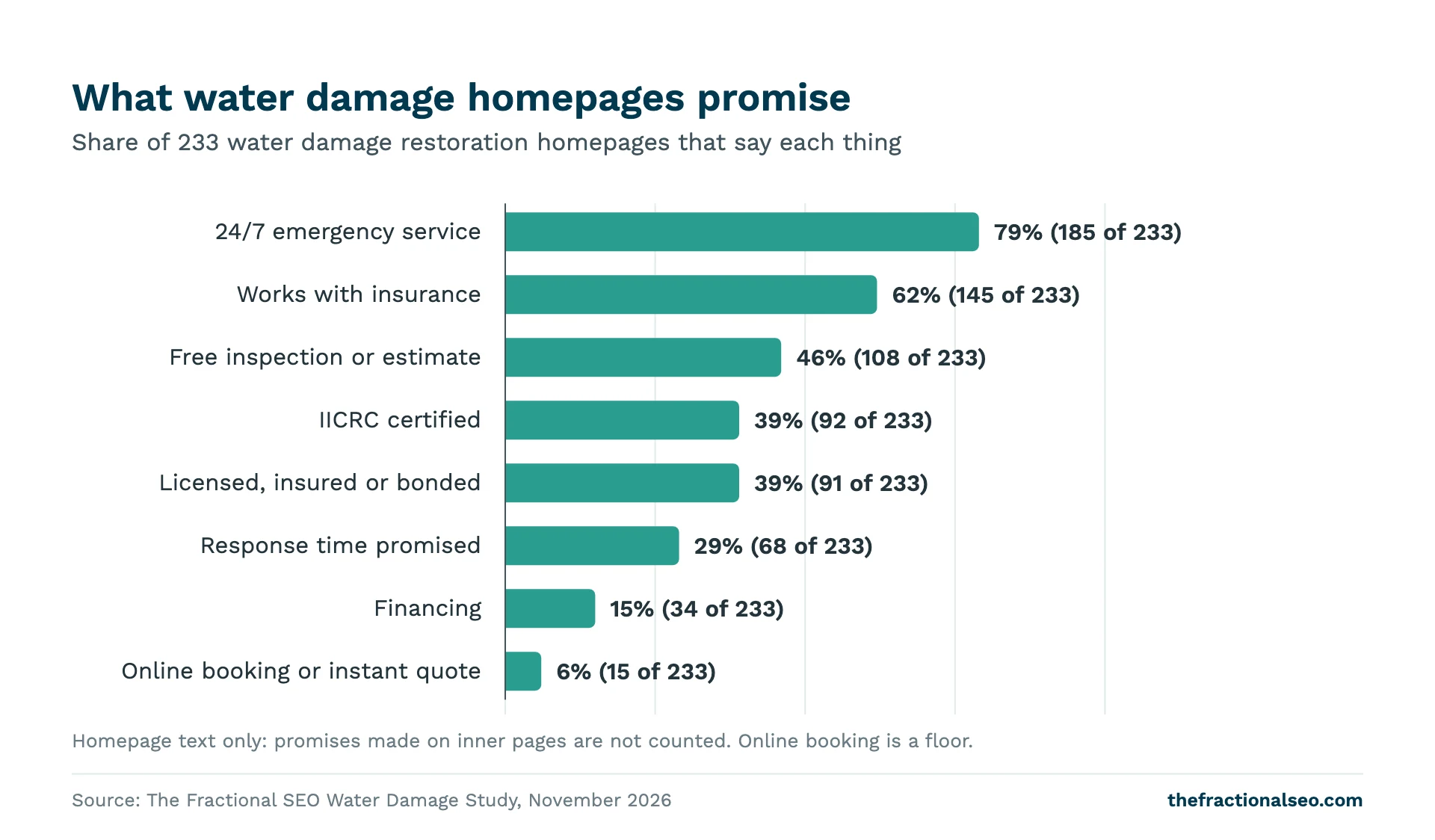
- Credentials and insurance often go unsaid: 62% of homepages say the company works with insurance, and 39% mention IICRC certification.
- Few can tell which calls came from search: call tracking shows on 12% of water damage homepages.
- No website feature separated top-ranked companies: not once the number of tests is taken into account, in Google Maps or the regular results. Our sample is small, so that is weak evidence of no effect, not proof.
- The clearest signal is on the profile: map-pack water damage businesses got a median of 8 new Google reviews in the 90 days before collection vs 3 for the rest.
Which gaps are majority gaps? Fewer than half of sites have a blog posted to in the last 12 months (13%), an IICRC mention (39%), a response-time promise (29%), a review widget (21%) or call tracking (12%). Most sites already have a homepage form (58%), an insurance message (62%) and the metro in the title (59%), and on-page basics are missing on a minority. Each gap below says which kind it is.
Why the website still matters
Most restoration company websites get very little search traffic on their own. The median water damage company website gets an estimated 23 organic visits a month, and 70% get fewer than 100. Companies that rank both in Maps and organically are the exception, with a median of 254 estimated visits, next to 23 for Maps-only and 14 for organic-only companies. These are modeled estimates, not measured traffic.
So most of the work a restoration website does is not pulling in searchers by itself. It is turning a click from the Maps listing into a call. The gaps below matter for that, whatever they do or don’t do for rankings.
Gap 1: A blog nobody has posted to in a year
60% of water damage company sites have a blog, but only 13% published anything in the last 12 months and 8% averaged a post a month. In counts: 140 of 232 sites have a blog, 31 posted in the last 12 months, and 19 have 12 or more posts in that time. Post dates came from our crawl, which stopped at 500 URLs per site, so very large blogs may be undercounted.
A blog didn’t separate top-ranked sites. Map-pack sites had one 61% of the time vs 62% lower in Maps, and organic top-3 sites 67% vs 58% at positions 4-10. Neither gap is meaningful.
So don’t start a blog to rank. If you have one, a page that says your last post was three years ago tells a homeowner the site isn’t looked after. Either keep it current or take the link out of your menu. The pages worth writing are the ones customers ask about on the phone: what happens in the first 24 hours after a pipe bursts, how drying is checked, and how the insurance claim works.
Gap 2: No way to reach you from the homepage except the phone
58% of water damage company websites have a contact or quote form on the homepage itself. Nearly all have a phone link: 91% of water damage company websites have a click-to-call phone link.
A homepage form showed no difference in either ranking comparison: 56% vs 57% in the map-pack comparison, 58% vs 57% in the organic one. It’s a customer feature. Many water damage jobs start with a phone call, and the phone should stay first. But a property manager reporting a leak in a unit, or a homeowner who found mold and wants an inspection next week, may prefer to send a message. A short form next to the phone number costs nothing.
Gap 3: Insurance help left unsaid
62% of water damage homepages say the company works with insurance. If you help with claims and your homepage doesn’t say so, a homeowner comparing two companies can’t tell.
In the map-pack comparison this was the closest any website feature came to a gap, and it still isn’t one. Map-pack sites mention insurance help a little more often (76% vs 59%), but the gap is not clear even before correction. Organic top-3 sites mention it 63% of the time vs 59% at positions 4-10.
In our view, for the person standing in a wet basement, the insurance question comes right after “can you come now?” If you bill the carrier directly, help with the claim, or work with adjusters every week, say so near the top of the homepage.
Gap 4: Credentials and response time kept quiet
Here is how often water damage homepages make the promises a homeowner looks for:
- IICRC certified: 39%
- Licensed, insured or bonded: 39%
- Free inspection or estimate: 46%
- Response time promised: 29%
IICRC publishes the S500, its “Standard for Professional Water Damage Restoration“, and its site has a search to locate a certified firm. If your technicians hold the certification, it is a plain trust signal, and only 39% of homepages mention it. The same goes for a response time you can actually meet.
None of these separated top-ranked companies either. IICRC was mentioned on 39% of map-pack sites vs 41% of the rest, and response-time promises 34% vs 27%. Neither gap is meaningful. Read these as ways to win the call once you’re found.
Gap 5: No city in the homepage title
59% of water damage company websites have their metro’s name in the homepage title tag. We counted the metro name only, not suburbs, so that is a floor: a title naming only a suburb isn’t counted.
Map-pack sites had the metro in the title 71% of the time vs 55% lower in Maps, and organic top-3 sites 46% vs 58%. Neither is a reliable difference, and they point opposite ways. Google’s SEO starter guide says a good title is “unique to the page, clear and concise”. Put your main service and service area in it because that tells a searcher you work where they are, not because this data shows it moves you up.
Gap 6: Reviews kept off the site
21% of water damage company websites show reviews through an embedded review widget. A site that quotes reviews as plain text isn’t counted here. Map-pack sites had a widget 29% of the time vs 21% lower in Maps, a gap that is not meaningful.
In our data, reviews leaned with the map pack on the Business Profile (recent reviews), not through a widget on the website. Showing them on the site is for the visitor who is deciding between you and the next company. More on what the reviews data shows in what 287 Business Profiles show about reviews and rankings.
Gap 7: No way to tell which calls came from search
Call tracking shows on 12% of water damage homepages (CallRail 10%), Google Tag Manager on 41%, a Google Ads tag on 15%, a Meta pixel on 9% and HighLevel on 7%. Tags loaded through Tag Manager are invisible to our check, so these are floors.
This one has nothing to do with ranking. It’s about knowing what works. If calls from your Business Profile, your website and your ads all ring the same number, nobody can tell you which one booked the job. That makes it hard to judge an agency, an ad budget or whether SEO is worth it for your company.
Gap 8: Slow mobile pages and blank on-page basics
On mobile, the median water damage homepage scores 71.5 out of 100 on Google’s Lighthouse performance test; 20% score 90 or more and 9% under 50. The median homepage takes 5.6 seconds to show its largest element in the simulated slow-phone test and weighs 2.2 MB. That is a lab test on a simulated slow phone, not real visitors, and scores vary from run to run.
Speed showed no clear difference between top-ranked companies and the rest: median mobile score 74.5 vs 70.5 (map pack vs lower in Maps) and 72 vs 70 (organic top 3 vs 4-10). A fast page still matters to someone on a phone in a flooded room.
On-page basics are missing on a minority of sites: 23% lack a meta description on a quarter or more of their pages, 13% lack an H1 on a quarter or more, and 4% duplicate titles on a quarter or more. WordPress runs 92% of water damage sites where the platform could be identified, so on many sites these are quick fixes in an SEO plugin. Google’s starter guide says a good meta description “is short, unique to one particular page”.
Did any of it separate top-ranked companies?
No. Here is every website feature we compared. There are two comparisons, with different samples. The map-pack comparison sets businesses at positions 1-3 of the Google Maps list for a study search against those at Maps positions 4-20. The organic comparison sets restoration sites at positions 1-3 of the regular results against those at positions 4-10.
When you run 64 tests, a few will look meaningful by luck, so we applied a standard correction (Holm) that raises the bar for each one. No row passed it.
| Website feature | Map pack 1-3 vs Maps 4-20 | Organic 1-3 vs 4-10 |
|---|---|---|
| Click-to-call | 90% vs 90% (p=1) | 88% vs 92% (p=0.68) |
| Homepage form | 56% vs 57% (p=1) | 58% vs 57% (p=1) |
| Review widget | 29% vs 21% (p=0.3) | 21% vs 19% (p=1) |
| LocalBusiness schema | 59% vs 68% (p=0.27) | 50% vs 77% (p=0.031) |
| City in title | 71% vs 55% (p=0.11) | 46% vs 58% (p=0.33) |
| Blog | 61% vs 62% (p=1) | 67% vs 58% (p=0.61) |
| Location pages | 59% vs 68% (p=0.27) | 63% vs 81% (p=0.094) |
| Service pages | 78% vs 83% (p=0.49) | 83% vs 92% (p=0.43) |
| 24/7 | 85% vs 80% (p=0.5) | 83% vs 71% (p=0.39) |
| Insurance help | 76% vs 59% (p=0.067) | 63% vs 59% (p=1) |
| IICRC | 39% vs 41% (p=0.86) | 38% vs 39% (p=1) |
| Response time | 34% vs 27% (p=0.43) | 29% vs 33% (p=1) |
| Free inspection | 54% vs 40% (p=0.15) | 46% vs 49% (p=1) |
| Licensed/insured | 46% vs 36% (p=0.28) | 42% vs 41% (p=1) |
| Financing | 20% vs 12% (p=0.31) | 17% vs 16% (p=1) |
| Online booking | 7% vs 8% (p=1) | 13% vs 0% (p=0.033) |
Two rows reached p<0.05 before the correction and both fail it. LocalBusiness schema is less common in the organic top 3 (50% vs 77%). And online booking appears on 3 of 24 organic top-3 sites against none lower down. Neither is a result to act on.
Be careful with “no difference” here, too. Our 27 searches give 81 map-pack slots, so only large gaps can show up as significant. “No clear difference” in this sample is weak evidence of no effect. It does mean nobody can honestly tell you that one website feature is what puts restoration companies in the map pack.
Speed and links told the same story. Page speed showed no clear difference in either comparison. Links show no clear edge either: map-pack businesses’ websites have a median of 114 referring domains vs 116 for those lower in Maps; organic top-3 sites 194 vs 94 referring domains at positions 4-10 (no clear difference), and Domain Rank 188 vs 138.5, a weak gap that fails the correction.
The clearest signal, and the only one that held up after correction, is off the website. Map-pack water damage businesses got a median of 8 new Google reviews in the 90 days before collection vs 3 for the rest. Over 30 days the gap was 2 vs 1, and that shorter window fails the correction. It’s a correlation, not proof that reviews put anyone there. Google’s own guidance on local ranking says local results are mainly based on “relevance, distance, and popularity”. In our data, review totals and links did not separate the map pack; recent reviews did lean with it. Our reviews study has the detail.
What restoration websites already get right
The basics are mostly in place. Every crawled water damage site uses HTTPS (232 of 232). 91% have a click-to-call phone link, and 79% of homepages promise 24/7 emergency service. 84% have dedicated service pages (water extraction, mold remediation, sewage cleanup and so on), with a median of 13 among those that do. 66% have LocalBusiness (or a subtype) structured data, though Google’s documentation says it “does not guarantee that features that consume structured data will show up in search results.”
67% of water damage company websites have location pages or service-in-city pages; among those that do, the median is 14.5 such pages. Location pages showed no reliable ranking difference either. Our local SEO guide for water damage restoration companies covers when a city page is worth building.
A 30-minute check of your own site
Open your homepage on your phone and work down this list. None of it is a ranking promise. All of it helps the person who just found you.
- Find your blog. If the newest post is more than a year old, update it or take it out of the menu.
- Check the homepage has a short form next to the phone number.
- Read the top of the homepage. Does it say you work with insurance, and how?
- Look for IICRC certification, your license and insurance, and a response time you can keep. Add the ones that are true.
- Check the homepage title tag names your main service and your area.
- Look for real reviews on the site.
- Ask whoever runs your marketing how calls from search are counted. If nobody can say, set up call tracking.
- Run your homepage through Google’s PageSpeed Insights on mobile, and check every main page has its own title, meta description and H1.
For the full list, including your Business Profile, use our local SEO checklist for water damage restoration companies.
FAQs
What are the most common SEO mistakes on water damage restoration websites?
One of the most common gaps is a blog nobody updates: 60% of sites have one, but only 13% posted anything in the last 12 months. Many homepages also leave out what homeowners ask about. 62% mention working with insurance and 39% mention IICRC certification. 58% have a form on the homepage. On-page gaps are less common: 23% of sites lack a meta description on a quarter or more of their pages.
Does a blog help a restoration company rank?
Not on this evidence. Map-pack sites had a blog about as often as the rest (61% vs 62%), and organic results showed no reliable difference either. Write useful pages because customers read them, not as a ranking tactic.
Does page speed matter for water damage SEO?
It showed no clear difference in our data: a median mobile score of 74.5 in the map pack vs 70.5 lower in Maps. The median homepage scores 71.5 and takes 5.6 seconds to show its largest element on a simulated slow phone. That is worth fixing for the visitor, whatever it does for rankings.
What does go with ranking in the map pack?
Nothing on the website, in our sample. On the Business Profile, the clearest signal and the only one that held up after correction was recent reviews: a median of 8 new Google reviews in 90 days vs 3. That is a correlation, and the 30-day version of the gap is weak. See our reviews study.
Want to know which of these gaps your site has, and which are worth fixing first? See how we work with water damage restoration companies.
More research & benchmarks
The whole Water Damage library- Google Reviews and Water Damage Rankings: What 287 Business Profiles Show Which parts of a water damage company's Google review profile lean with the map pack, and…
- Who Wins Local Water Damage Searches: A Benchmark of 27 Searches Who holds page one, the map pack and the ad slots when homeowners search for water…