
Research & Benchmark Construction
The Impact of Local Reviews on Construction Company Rankings
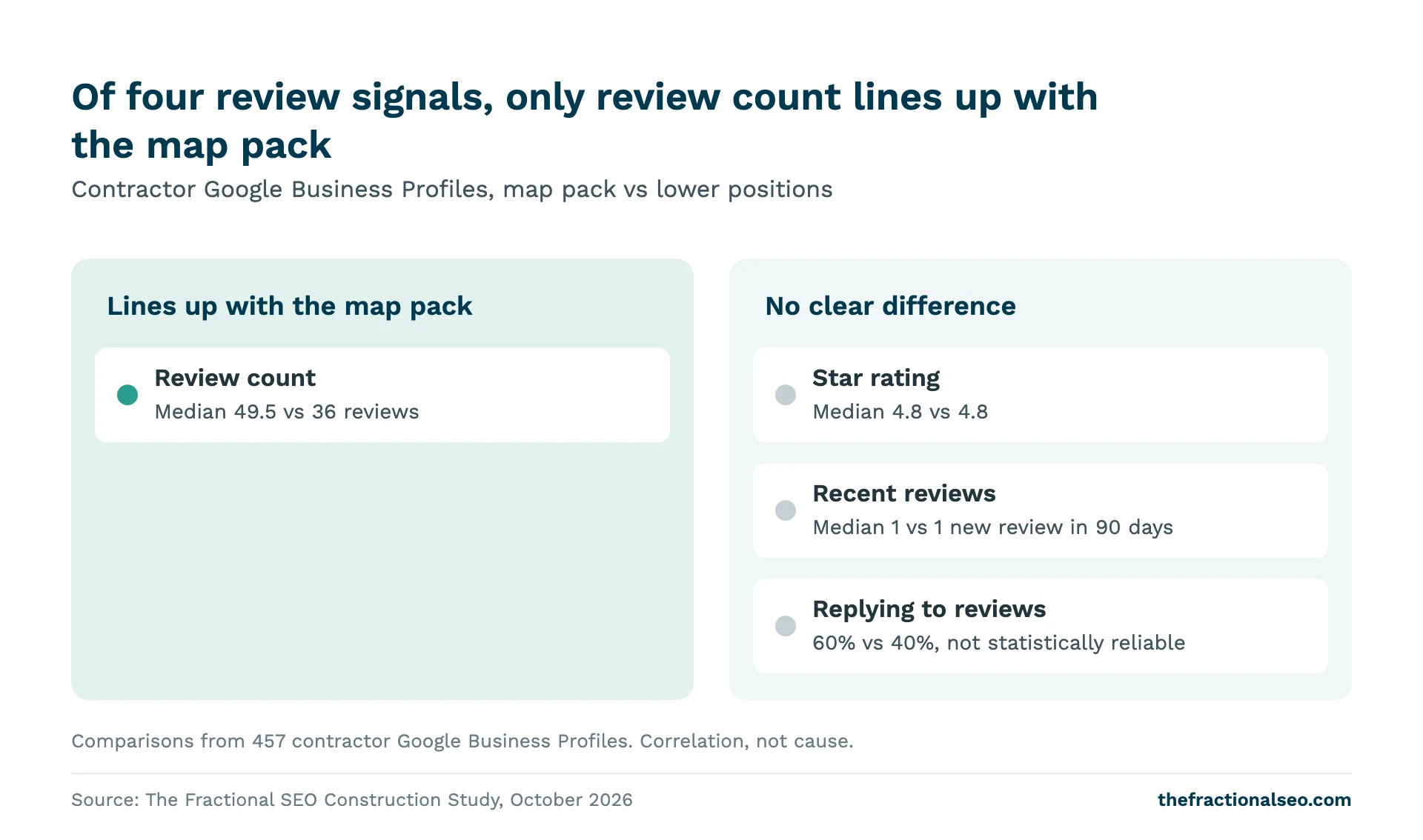
Every guide to local SEO tells contractors to get more Google reviews. Fewer say which part of a review profile actually lines up with the map pack: the count, the star rating, how many came in lately, or whether the owner replies. We checked. For contractors, the number of reviews is the clearest signal in our data. Star rating and recent review volume show no clear difference between the businesses in the map pack and the ones below it.
We analyzed 100 local searches across 25 US metros and four contractor types, 1,034 contractor websites (965 crawled) and 457 Google Business Profiles, October 2026. This piece uses the Google Business Profile side of that study: 300 map-pack listings compared with 399 listings at positions 4-7, and a deeper look at 457 unique profiles.
One caution before the numbers. This is a comparison of what top-ranked contractors have with what lower-ranked ones have. It shows what goes together. It can’t show that adding reviews moves a listing up, and we’ve written it that way throughout.
Key findings
- Review count lines up with the map pack. Map-pack businesses have a median of 49.5 reviews for positions 1-3 vs 36 for positions 4-7.
- Star rating doesn’t separate them. The median is 4.8 both in the map pack and at positions 4-7.
- Recent reviews don’t either. Both groups got a median of 1 new review in the last 90 days.
- Replies lean toward the map pack, but not reliably. Map-pack owners reply to a median of 60% of their newest 20 reviews vs 40% at positions 4-20. The gap is not statistically reliable in this sample.
- Few make the map pack on a handful of reviews. Only 3% of map-pack listings have fewer than 10 reviews, and three-quarters have 27 or more.
Review count: the clearest signal in the data
We pulled the Google Maps results list for each of the 100 searches and recorded every listing’s review count. Every search showed at least seven businesses, so we compared positions 1-3 (the three that show in the map pack on a results page) with positions 4-7.
Map-pack businesses have more reviews: a median of 49.5 reviews for positions 1-3 vs 36 for positions 4-7. That gap is strong enough that chance is an unlikely explanation.
One problem with a listing-level comparison is that the same business can turn up in several searches. A firm that shows up for “general contractor” and “remodeler” in the same city would be counted twice. So we ran it a second way, counting each business once by its Google ID. Total reviews: median 48 for businesses that have been in a map pack vs 33 for those only at positions 4-20. Same direction, similar size.
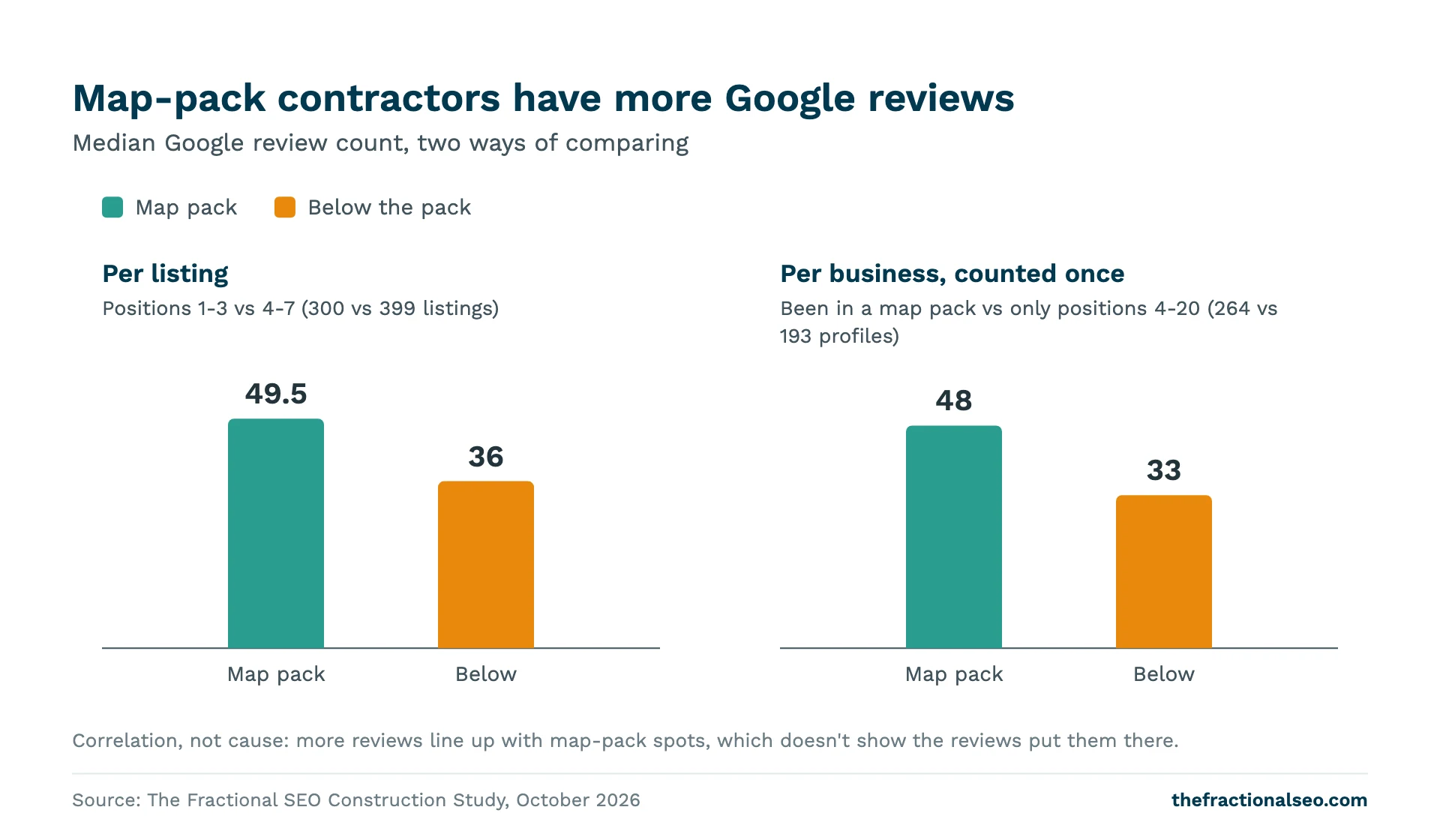
Now the part most review articles leave out. Correlation is not cause. A business with 50 reviews has usually been around longer than one with 15. It has done more jobs, has more people searching its name, more links pointing at its site and more history with Google. Reviews pile up alongside all of that. So when we say review count is the clearest signal, we mean it’s the review measure that differs most between the two groups. We can’t tell you how much of the gap is the reviews and how much is everything that comes with them.
Google’s own help page is consistent with the direction, if not the size. In its tips to improve your local ranking, Google says how well-known a business is depends partly on its reviews, and that “more reviews and positive ratings can help your business’s local ranking.” It gives no number.
The practical reading: review count is worth working on, because it’s one of the few things that differs and that you control directly. Just don’t expect it to work alone.
Star rating makes no clear difference
This is the finding that surprises owners most. Star rating does not separate them: the median is 4.8 both in the map pack and at positions 4-7.
There’s a simple reason. Contractor ratings cluster between 4.7 and 5.0, so there’s very little room for them to differ. Almost everyone who shows up in a local search has a good rating. A 4.9 next to a 4.7 doesn’t stand out to Google, and in our data it doesn’t line up with a better position.
That doesn’t make a rating irrelevant. A searcher comparing three contractors will notice a 3.9, and a run of bad reviews costs calls whatever it does to rankings. But chasing a perfect 5.0, or worrying that one four-star review is holding you back, looks like misplaced effort. If your rating is in the high fours, the number of reviews is the more useful thing to work on.
We’d also say this plainly: don’t filter who you ask. Asking only the customers you’re sure will give five stars (sometimes called review gating) is against Google’s review policies, and it slows down the count, which is the part that does line up with the map pack.
Recent review volume makes no clear difference either
Plenty of local SEO advice says recency matters most: that Google rewards a steady flow of new reviews, and a profile that went quiet will slip. For contractors, our data doesn’t show it.
Review velocity does not separate them: both groups got a median of 1 new review in the last 90 days. That’s one review a quarter for the typical contractor, in the map pack or out of it.
A few notes on what this does and doesn’t mean. Contractors finish fewer jobs than a restaurant or a dentist serves customers, so review flow is slow across the board, and with medians of one there isn’t much spread to compare. We also capped the 90-day count at 40 for 12 very active profiles, which doesn’t change a median of one. And general advice from all-industry surveys may still hold for businesses with high customer volume. It just isn’t what we found in construction.
So recency isn’t a reason to panic about a slow month. It is a reason to make asking routine. A total of 50 reviews is built one job at a time, and the only way to get there is to ask at every closeout.
Replying to reviews: a lean, not a result
Owners of map-pack businesses reply to more reviews (median 60% of their newest 20 vs 40% at positions 4-20), but the gap is not statistically reliable in this sample. In plain terms: the direction is there, but it’s small enough that it could be chance. We wouldn’t build a ranking plan on it.
What stood out more is how split contractors are. 26% replied to none of their newest reviews, while 29% replied to 90% or more. Most firms either have a habit of replying or they don’t.
Our advice is to reply anyway, for a reason that has nothing to do with rankings. Your reviews are read by the next homeowner or project manager deciding whether to call. A short, specific reply to a good review shows someone is paying attention. A calm reply to a bad one often does more for your reputation than the review did against it. Google’s help page makes the same point: replies help a business stand out. Treat replies as customer service, and you won’t need a ranking reason.
Benchmarks: reviews by contractor type and market size
Averages across all contractors hide big differences between trades. Here are the medians for the businesses in positions 1-3, split by the kind of search and by the size of the metro.
| Map-pack listings (positions 1-3) | Median reviews |
|---|---|
| By search type | |
| Remodeler | 77 |
| Home builder | 51 |
| General contractor | 45 |
| Commercial contractor | 25 |
| By market size | |
| Large metros | 50 |
| Mid metros | 51 |
| Small metros | 45 |
Two things stand out. First, contractor type matters far more than city size. Remodelers in the map pack have a median of 77 reviews; commercial contractors have 25. That makes sense: remodelers work for homeowners, who leave reviews, while commercial firms win work through bids and relationships, and their clients rarely write a Google review. Second, the market-size figures are close together. A map-pack spot in a smaller metro doesn’t take dramatically fewer reviews than one in a large metro. These are descriptive medians with no test run, and the small-metro group is only five metros, so read them as a rough guide.
The floor is clearer than the median. Very few businesses make the map pack on a handful of reviews: only 3% of map-pack listings have fewer than 10 reviews, and three-quarters have 27 or more. If you’re under 10, you’re competing against almost nobody at your level.
For a deeper look at the numbers by trade, see how many Google reviews a contractor needs for the map pack.
Reviews on your own website
Google reviews live on Google. Most contractors leave them there. Only 11% of contractor websites have reviews or testimonials embedded on the site.
Our crawl didn’t find that review widgets line up with better rankings, so this isn’t a ranking tip. It’s a sales one. A visitor who lands on your site from an ad, a directory or a referral may never see your Google profile. Putting a few real reviews on your service and location pages, next to photos of the work they describe, gives that visitor the same reassurance a map-pack searcher gets. Use real customers’ words, with their permission, and keep them current.
What this means for your review strategy
Put together, the data points to a plain, unglamorous plan.
- Ask after every finished job. Build the request into closeout: the walkthrough, the final invoice, the warranty letter. Send a direct link to your review form. One review a quarter is the median; a routine is how you get ahead of it.
- Know your local benchmark. Look at the three businesses in the map pack for your main search in your city and note their review counts. Use the table above as a starting point, but your own market is the real comparison.
- Don’t chase the rating. If you’re in the high fours, a perfect score isn’t the gap. Ask everyone, not only the happy ones.
- Reply as a habit. Not because the data shows a ranking edge (it doesn’t, reliably), but because buyers read the replies.
- Put reviews where buyers decide. Add real reviews to your website’s service and location pages.
Reviews are one part of a local profile. Our Google Business Profile guide for contractors covers the rest, and the construction local SEO guide puts it in the context of your website. For how websites in the same study compare, see our analysis of 965 construction websites.
Want to know how your review count compares in your own market? Ask us for a local visibility review.
How we did this
We analyzed 100 local searches across 25 US metros and four contractor types, 1,034 contractor websites (965 crawled) and 457 Google Business Profiles, October 2026.
Samples: map-pack listings, 300 at positions 1-3 vs 399 at positions 4-7 (review count and star rating). Profile deep sample, 457 unique profiles counted once each by Google ID: 264 that have been in a map pack vs 193 only at positions 4-20 (total reviews, recent reviews, replies). Website crawl, 965 sites (reviews on the website). Recent reviews are the last 90 days, capped at 40 for 12 profiles. Reply rate is the share of each profile’s newest 20 reviews with an owner reply.
What it can’t claim: this is a correlation study. It compares what higher- and lower-ranked contractors have; it does not show that changing any one of these causes a ranking change. “No clear difference” means we found none in this sample, not that none exists.
Questions, answered
Do Google reviews help contractors rank?
Review count lines up with the map pack. Map-pack contractors have a median of 49.5 reviews vs 36 at positions 4-7, and counting each business once, 48 vs 33. That’s a correlation: established firms have more reviews and other advantages too. But review count is the review measure that differs most.
Does star rating affect map-pack rankings?
Not in our data. The median rating is 4.8 both in the map pack and at positions 4-7, because nearly all contractors rate between 4.7 and 5.0. A good rating still matters to the people reading it.
Do recent reviews matter more than total reviews?
For contractors, we found no clear difference in recent reviews: both groups got a median of 1 new review in the last 90 days. Total count is where the gap shows up. Steady asking builds that total.
Should contractors reply to every review?
We’d reply to every one, as customer service. Map-pack owners do reply to more reviews (a median of 60% of their newest 20 vs 40%), but the gap isn’t statistically reliable. 26% of contractors reply to none, and buyers notice.
More research & benchmarks
The whole Construction library- Who Wins Local Construction Searches in 2026: A Benchmark of 100 Searches Who holds page one and the map pack for local construction searches, by contractor type, across…
- How Many Google Reviews Does a Contractor Need to Make the Map Pack? Review benchmarks from 300 map-pack listings, by contractor type and market size, and how to set…
- Do Contractors Need Location Pages? What 965 Contractor Websites Show Only 28% of contractor sites have location pages, yet they were the one website feature that…