
Research & Benchmark Healthcare
Google Reviews and Clinic Rankings: What 534 Business Profiles Show
The guides to patient reviews we read say Google reviews help a clinic rank. None of them measures it. We checked 534 Google Business Profiles for urgent care, primary care and dermatology clinics. Clinics in the map pack stand apart on two things: how many reviews they have in total and how many came in recently. Star rating, photos, reply rate and Google posts made no clear difference.
We analyzed 27 local searches across 9 US metros and three clinic types (urgent care, primary care and dermatology), 301 provider websites (261 crawled) and 534 Google Business Profiles, November 2026. For this article we looked at the review side of those profiles: total reviews, new reviews, star rating, photos, owner replies and Google posts. We compared clinics that reach the map pack with the rest, split the results by clinic type and by who runs the clinic, and set out the review counts map-pack clinics actually have.
The searches were “urgent care”, “primary care doctor” and “dermatologist”, each followed by the metro name. We ran these searches once, on 17 November 2026, so treat rankings as a snapshot: they move from week to week.
Urgent care, primary care and dermatology are different businesses with different patients, so we give the figures by clinic type wherever they differ. They differ a lot.
Key findings
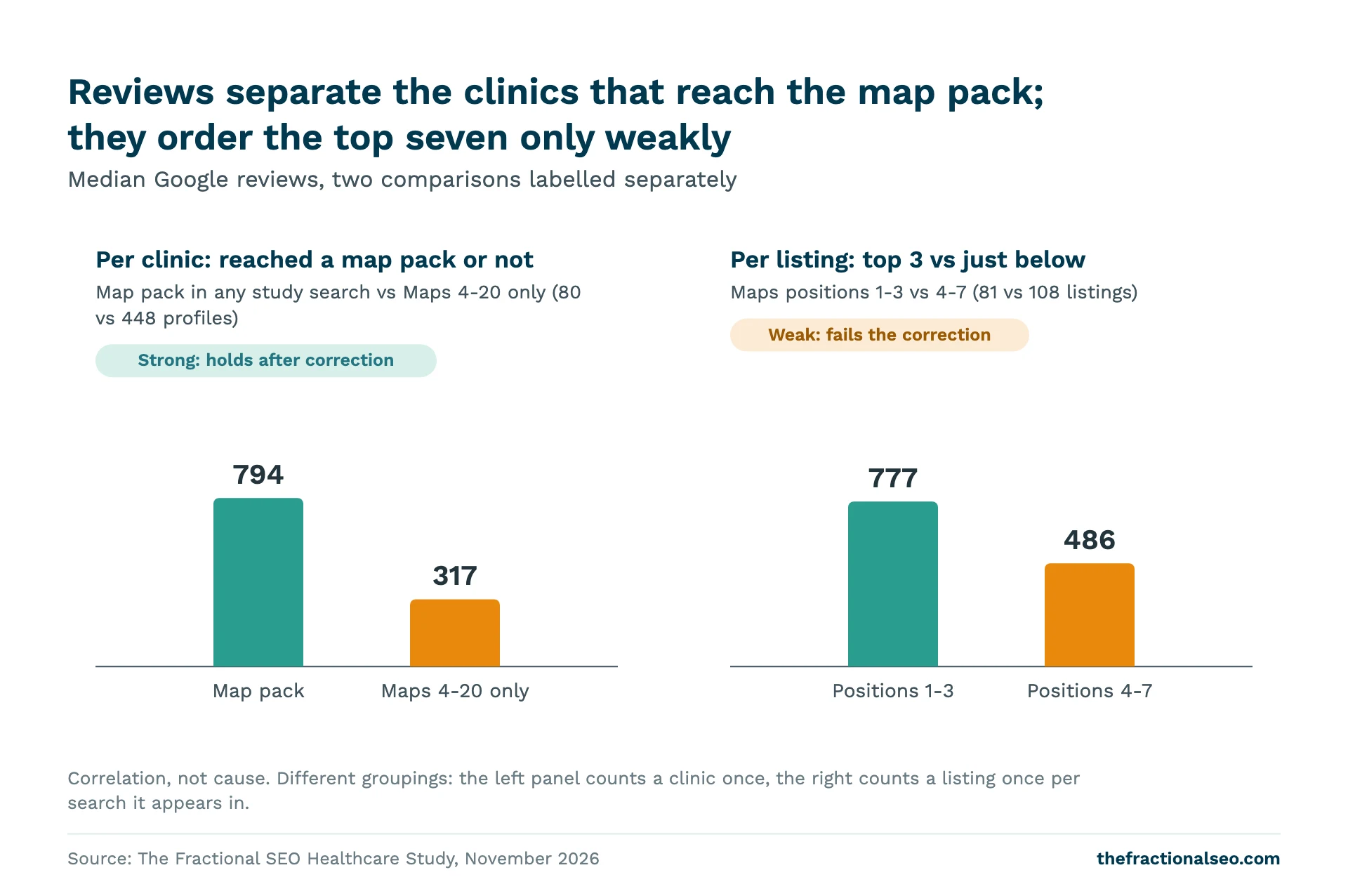
- Total reviews (strong): clinics that reached a map pack have a median of 794 Google reviews vs 317 for those only seen at Maps positions 4-20. Independent clinics alone show the same gap (835 vs 323).
- New reviews (strong): map-pack clinics got a median of 39 new reviews in the 90 days before collection vs 15 for the rest, and 12 vs 5 in 30 days.
- By clinic type: the same direction in all three, but clear on its own only in dermatology.
- Top 3 vs just below (weak): on one search, positions 1-3 have a median of 777 reviews vs 486 at positions 4-7, a lean that fails the correction.
- No clear difference: star rating (4.7 vs 4.7), photos, reply rate and Google posts.
- The bar differs by clinic type: the map-pack median is 1,097 reviews for urgent care, 1,048 for dermatology and 291 for primary care.
The website findings from the same study are in our study of 261 clinic websites.

Do Google reviews help clinics rank? Map-pack clinics have far more
Providers that reached a map pack have far more Google reviews: a median of 794 vs 317 for those seen only at Maps positions 4-20. That counts each clinic once: 80 clinics that made a map pack in at least one study search against 448 that only showed lower in the Maps list. Six profiles had no review count and are left out.
In this study, the map pack means the top three clinics in the Google Maps list for each search. Positions 4-20 are the rest of the first 20 listings. The gap survives the correction for the number of tests we ran, so it is unlikely to be chance. It also holds for independent clinics alone (835 vs 323, 50 vs 253 clinics), so it isn’t just big health systems and chains pulling the numbers up.
Google says something similar in general terms. Its help page on local ranking says prominence is based partly on how many reviews a business has, and that more reviews and positive ratings can help a business’s local ranking.
None of this proves that reviews put a clinic in the pack. Established clinics tend to have more reviews and other advantages too: more years open, more locations, more links. Map-pack providers have a median of 297 referring domains vs 166, though that lean fails the correction. So the plain answer is that review count leans with the map pack in our data.
By clinic type: clear on its own only in dermatology
By clinic type: dermatology 1,048 vs 376, urgent care 1,097 vs 594, primary care 324 vs 106: same direction in all three, clear on its own only in dermatology. Recent reviews split the same way.
| Clinic type (search) | Median reviews: map pack vs Maps 4-20 only | New reviews in 90 days: map pack vs the rest | Clinics compared |
|---|---|---|---|
| Urgent care | 1,097 vs 594 | 38 vs 28 | 27 vs 153 |
| Primary care doctor | 324 vs 106 | 19 vs 4 | 26 vs 148 (reviews); 27 vs 153 (new reviews) |
| Dermatologist | 1,048 vs 376 | 40 vs 20 | 27 vs 153 |
Why only dermatology? Each clinic type has just 27 map-pack profiles, so a gap has to be large and steady to stand out on its own. Urgent care and primary care point the same way, but with groups this small their gaps are not clear enough to count alone. That is not the same as no gap: across all three types together the result is strong.
New reviews: map-pack clinics keep collecting them
Map-pack providers also got more new reviews in the 90 days before collection: a median of 39 vs 15, and 12 vs 5 in 30 days. Both survive the correction and hold for independents alone (39.5 vs 14 in 90 days). That compares 81 clinics that reached a map pack with 453 that didn’t, each counted once.
The real gap is probably bigger than this. We collected each profile’s newest 40 reviews, and 154 profiles had 40 or more in 90 days (urgent care 69, dermatology 59, primary care 26). So the pack median of 39 is near the cap and the real gap is likely larger.
One more detail runs the other way, and it doesn’t change the result. The last batch of profiles was collected eight days after the rest, and none of them was in a map pack. A later collection can only raise the non-pack counts, which would make the gap look smaller, not bigger.
Top 3 vs just below: a weaker gap
Measured on the Maps list itself, the gap between positions 1-3 and positions 4-7 is smaller: a median of 777 vs 486 reviews, a lean that fails the correction. That compares 81 map-pack listings with 108 listings at positions 4-7, counting a clinic once for each search it shows up in. Keyword-named listings our rules flagged as suspect don’t explain it: without them the medians are 777 vs 490.
Reviews mark the clinics that reach the pack anywhere more clearly than they order the top seven of one search. In our HVAC study the same comparison was 1,576 vs 615, a strong result.
Why 486 here and 317 above? Different groupings. This one counts listings at positions 4-7 in each search; the one above counts each clinic once and includes everything down to position 20.
Health systems: fewer reviews in urgent care and dermatology, not in primary care
Health-system listings have fewer reviews than independent clinics on urgent care and dermatology searches (urgent care median 318 vs 560; dermatology 17 vs 514, few health-system profiles), but not on primary care searches, where they have slightly more (171 vs 154). We report four groups separately: hospital and health-system programs, company-owned clinic chains, the one franchise brand (AFC Urgent Care) and independent clinics.
| Clinic type (search) | Health system | Company chain | Franchise (AFC Urgent Care) | Independent |
|---|---|---|---|---|
| Urgent care | 318 (34) | 1,031 (67) | 1,879 (8) | 560 (68) |
| Primary care doctor | 171 (62) | 55.5 (16) | none | 154 (90) |
| Dermatologist | 17 (5) | 592 (21) | none | 514 (152) |
These figures describe the groups; we tested nothing here. Pooled across all three clinic types the health-system median looks lowest, but that is a mix of clinic types: most health-system profiles are primary care, where every group has few reviews. So read it by type. The franchise figure rests on 8 profiles, the dermatology health-system figure on 5. Health systems reach the pack and page one on other strengths.
Independent clinics still hold most map-pack spots: 50 of 81 (62%), and 24 of 27 on dermatology searches, 16 of 27 on primary care, 10 of 27 on urgent care. Who else holds those spots is in who wins local healthcare searches.
Rating, photos and posts made no clear difference
Star rating does not separate them: the median is 4.7 in the map pack and 4.7 at positions 4-7. That compares 80 map-pack listings with 108 just below. Ratings cluster between 4.5 and 5.0, so there is little room to differ.
Photos show no clear difference: map-pack profiles have a median of 18 vs 14. Primary care profiles have very few photos either way (5 vs 6), urgent care the most (28 vs 23). Our HVAC and landscaping studies found more photos in the pack; clinics don’t show it. Photo counts include photos patients post.
Google posts show no edge: 15% of map-pack profiles and 16% of the rest posted in the 30 days before collection. 36% of all profiles have never posted.
In our view a good rating and a few current photos of the building, the entrance and the waiting room still help a patient decide where to go. They just don’t mark the map pack in this data. Our Google Business Profile checklist for clinics covers photos, posts, categories and claiming the profile.
Replying to reviews: no clear difference, and a privacy limit
Replying to reviews shows no clear difference: a median reply rate of 65% of the newest 20 reviews in the map pack vs 55%. Providers split into camps: 29% reply to none of their newest 20 and 32% reply to 90% or more. That compares 78 map-pack clinics with 440 others, counting only profiles with 5 or more reviews.
Clinics have a reason to be careful that most businesses don’t. A public reply should never confirm that the reviewer is a patient or mention their visit, condition or care, even when the review itself does. A safe reply thanks the person in general terms and invites them to call the office to talk it through. Write your reply policy with your privacy or compliance counsel.
Reply anyway if you can do it that way. Google’s help page on managing reviews says replying shows people you value their feedback, and the next patient reading your profile sees the replies too. It just doesn’t mark the map pack here.
How many Google reviews do clinics need?
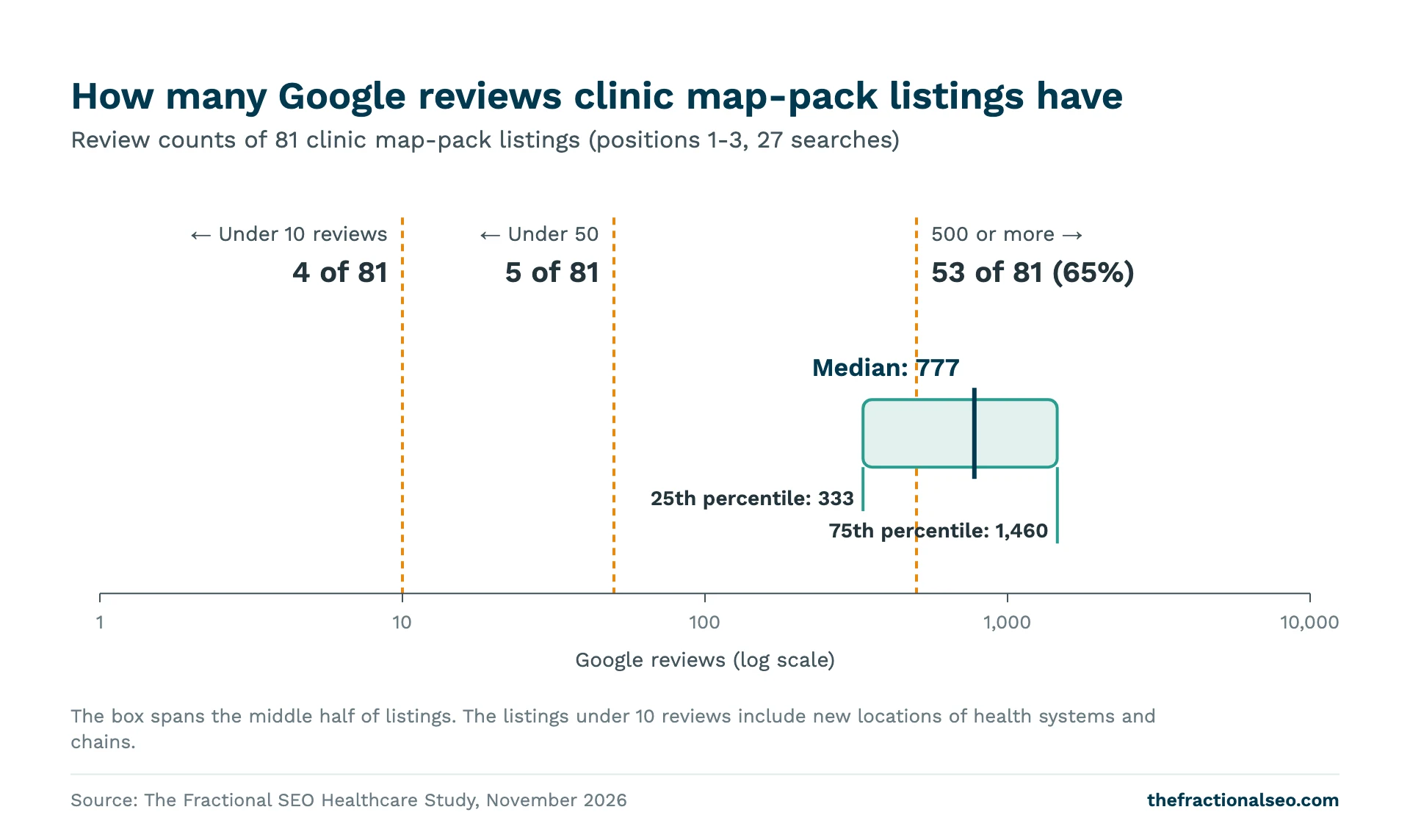
Google doesn’t publish a minimum, and no review count guarantees a spot. Here is what the 81 map-pack listings in the study actually have. Few providers reach the map pack on a handful of reviews: 4 of 81 map-pack listings have fewer than 10, three-quarters have 333 or more, the median is 777 and 53 (65%) have 500 or more.
- Fewer than 10 reviews: 4 of 81. These include new locations of health systems and chains.
- Fewer than 50 reviews: 5 of 81.
- 25th percentile: 333. Three-quarters of map-pack listings have 333 or more.
- Median: 777.
- 75th percentile: 1,460.
- 500 or more: 53 (65%).
By clinic type
The bar differs by clinic type: median 1,097 for urgent care, 1,048 for dermatology and 291 for primary care.
| Search (plus the metro) | Map pack (positions 1-3) | Positions 4-7 | Map-pack listings |
|---|---|---|---|
| urgent care | 1,097 | 625 | 27 |
| dermatologist | 1,048 | 713 | 27 |
| primary care doctor | 291 | 160 | 27 |
By market size
| Market size | Metros in the study | Median reviews in the map pack | Map-pack listings |
|---|---|---|---|
| Large | New York, Los Angeles, Chicago, Dallas | 678 | 36 |
| Mid | Charlotte, Nashville, Austin | 777 | 27 |
| Small | Boise, Knoxville | 910 | 18 |
Small metros have the highest median, 910, from only 18 listings. We didn’t test why. These medians describe what map-pack clinics had in these 9 metros. They are not targets, and reaching one won’t earn a spot on its own.
What it means for each clinic type
Urgent care. The bar is high: a map-pack median of 1,097 reviews. Independents hold only 10 of the 27 urgent care pack spots, so you compete with chains and health systems as well as other independents. Steady new reviews are the part you control week to week.
Primary care. Counts are far lower (291 in the pack, 160 at positions 4-7), so a few hundred reviews can put you in range. Health systems hold 9 of the 27 primary care pack spots with review counts close to independents’ (171 vs 154), and they win on other strengths.
Dermatology. This is where reviews separate clinics most clearly, on totals (1,048 vs 376) and on recent reviews (40 vs 20). Independents hold 24 of the 27 dermatology pack spots, so the clinics you are measured against are mostly other independents.
That is our reading of the data, not a tested rule. The local SEO checklist for medical clinics puts reviews in order with the rest of the work.
Asking patients for reviews
This part is our advice, not study data. Ask every patient, not only the ones you expect to be happy. Google’s help page says you can share a review request link or QR code: put it in the visit follow-up text or email and on a card at checkout. Don’t ask patients to describe their condition or treatment.
Never pay for reviews or offer anything for them. Google’s content policy bans incentives “such as payment, discounts, free goods and/or services” and says a review should reflect a genuine experience. If you use software to send requests, our list of patient booking, messaging and review software notes which vendors say they sign a business associate agreement.
Reviews on your website
12% of provider sites show a review widget, out of 261 crawled. Review widgets show up on 23% of map-pack clinics’ sites vs 10% for clinics only at Maps positions 4-20 (57 vs 173 sites), a lean that fails the correction.
Want to see how your profile compares with your own market’s map pack, for your type of clinic? Talk to us about SEO for urgent care, primary care and dermatology clinics.
How we did this
We analyzed 27 local searches across 9 US metros and three clinic types (urgent care, primary care and dermatology), 301 provider websites (261 crawled) and 534 Google Business Profiles, November 2026.
Searches were “urgent care”, “primary care doctor” and “dermatologist”, each followed by the metro. Map pack means positions 1-3 of the Google Maps list for each search. Most comparisons count each clinic once: those that reached a map pack in any study search vs those only at positions 4-20. The top-3 vs 4-7 and star rating comparisons count listings once per search. New reviews come from each profile’s newest 40, replies from the newest 20.
What it can’t claim: cause. Established clinics tend to have more reviews and other advantages. Each clinic type has only 27 map-pack profiles, so “no clear difference” means none was found here, not that none exists. One snapshot, with no “near me” searches.
Questions, answered
Do Google reviews help a clinic rank?
Review count leans with the map pack. Clinics that reached a map pack have a median of 794 reviews vs 317 for the rest, a strong gap that holds for independents alone. That’s a correlation, not proof.
How many Google reviews does a clinic need?
There’s no fixed number, and it depends on the clinic type. Map-pack listings had a median of 1,097 reviews in urgent care, 1,048 in dermatology and 291 in primary care. Check your own market.
Does replying to reviews help ranking?
We found no clear difference: a median reply rate of 65% in the map pack vs 55%. Reply for the patients reading your profile, and never confirm in a reply that the reviewer is a patient.
Does star rating affect map-pack rankings?
We found no clear difference. The median is 4.7 in the map pack and 4.7 at positions 4-7, because ratings cluster between 4.5 and 5.0.
Do health systems have more reviews than independent clinics?
It depends on the clinic type. On urgent care searches health-system listings have a median of 318 reviews vs 560 for independents, and on dermatology searches 17 vs 514. On primary care searches they have slightly more (171 vs 154). They reach the pack on other strengths.
More research & benchmarks
The whole Healthcare library- We Analyzed 261 Clinic Websites: The SEO Gaps Most Clinics Leave Open Seven common gaps on clinic websites, measured across 261 urgent care, primary care and dermatology sites,…
- Who Wins Local Healthcare Searches: Health Systems, Chains and Independent Clinics in 27 Searches Who holds page one and the map pack when patients search for urgent care, a primary…