
Guide Construction
Houzz, Yelp and BBB: Why Directories Outrank Contractors, and How to Use Them
Search for a contractor in almost any US city and you'll find directories mixed in with the contractors. Only 57% of page-one organic results for local construction searches went to contractor websites in our study. The other 43% went to directories, social sites, news, government pages, trade associations and chambers of commerce. We analyzed 100 local searches across 25 US metros and four contractor types, 1,034 contractor websites (965 crawled) and 457 Google Business Profiles, October 2026.
That’s a lot of page one going to sites that aren’t you. Most contractors treat it as a problem. It’s more useful to treat it as a list of places to be. This guide covers why directories rank so well, which ones show up most for construction searches, and how to use Houzz, Yelp, BBB and the rest without paying for things you don’t need.
The short answer
- Houzz and Yelp dominate: houzz.com appeared on page one 66 times across our 100 searches and yelp.com 65 times. The next directory, bbb.org, appeared 17 times.
- Start free: claim and complete the free profiles before you consider any paid plan.
- Read the contract: Houzz says most Houzz Pro plans are annual 12-month contracts.
- Don’t stop at the listing: 16% of map-pack listings showed no website link on the Maps list card. A directory profile is a route to your site, not a replacement for it.
Why directories outrank contractor websites
Directories don’t just show up. They often win. In our data, a non-contractor site held the #1 organic spot in 28% of searches, and 40% of all top-3 spots.
There are a few reasons, and none of them is a secret deal with Google:
- Links. Sites like Yelp and Houzz have collected links from a vast number of sites over many years. The median top-3 contractor site in our data had 582 referring domains.
- Pages built for the search. A directory has a page called something like “Best general contractors in Denver” for every city and trade. That page matches the search word for word, and most contractor sites don’t have one like it.
- Choice. Someone searching “remodelers near me” may want to compare. A list of twenty firms with reviews answers that better than any single firm’s homepage.
- Fresh reviews. Directory pages change every time a customer leaves a review, so they rarely go stale.
Google’s local ranking help page says prominence is based partly on “how many websites link to your business and how many reviews you have” (Google Business Profile Help). Directories are strong on both. That’s why the better plan is to be on them, not to try to outrank them on every search.
Which directories show up most
We counted every directory result on page one across 100 local construction searches. Two sites stand far above the rest.
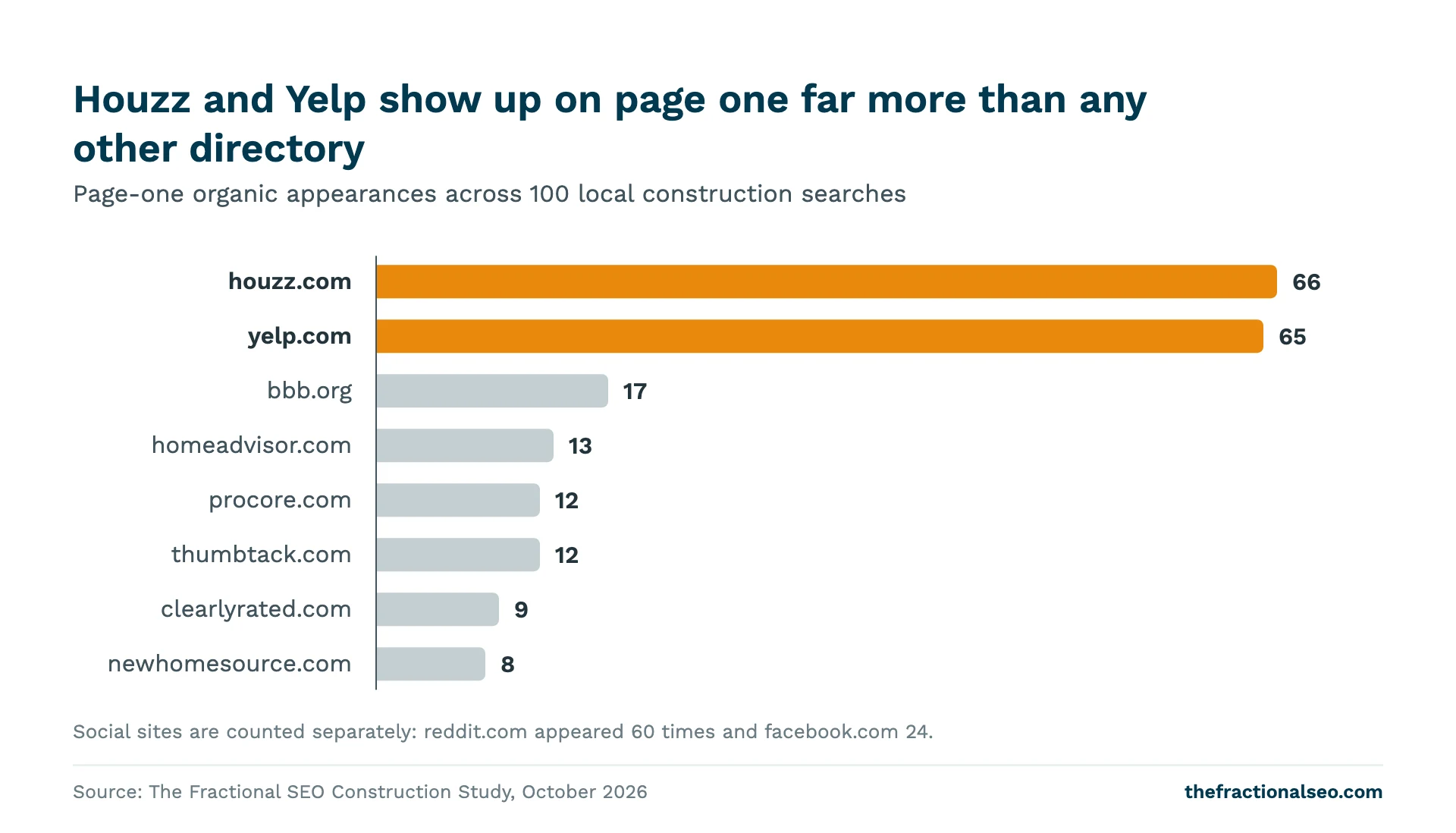
| Directory | Page-one appearances (100 searches) |
|---|---|
| houzz.com | 66 |
| yelp.com | 65 |
| bbb.org | 17 |
| homeadvisor.com | 13 |
| procore.com | 12 |
| thumbtack.com | 12 |
| clearlyrated.com | 9 |
| newhomesource.com | 8 |
One note on the count: social sites are counted separately. reddit.com appeared 60 times and facebook.com 24 times, which would put them third and fourth among all non-contractor sites. Reddit threads where homeowners ask for contractor recommendations are their own topic, and not one you can list yourself on.
The full breakdown of who ranks, by search type and market size, is in our local construction search benchmark.
How it varies by contractor type
How much room directories leave you depends on what you build. Contractor websites held a different share of page one depending on the search:
| Search type | Share of page one that is contractor sites |
|---|---|
| General contractor | 50% |
| Remodeler | 56% |
| Home builder | 60% |
| Commercial contractor | 62% |
General contractor searches are the most crowded with non-contractor sites; commercial contractor searches the least. The directories that appear also follow the buyer. Houzz is built around home design and remodeling, NewHomeSource around new-home buyers, and ClearlyRated and Procore around business clients. Search your own main terms in your own city, note which directories appear, and start with those. Our beginner’s guide to SEO for general contractors covers what to do on the rest of the page.
Houzz for contractors
Houzz appeared on page one more than any other site in our searches. If you’re a remodeler, design-build firm or custom home builder, it’s probably the directory your clients already browse for ideas.
Who it suits
Houzz Pro’s own site lists builders, remodelers and interior designers among the trades it’s built for (Houzz Pro). It suits residential work that photographs well: kitchens, baths, additions, whole-home renovations and custom homes. It’s a weaker fit for commercial contractors, whose buyers rarely browse Houzz.
Set up the profile properly
- Use your business name exactly as it appears everywhere else.
- Choose the professional category that matches your main work.
- Add your address or service area, phone and website, matching your Google Business Profile.
- Upload real projects with a short write-up for each: what the client wanted, what you built, where.
- Ask past clients for Houzz reviews alongside Google ones.
Houzz’s sign-up flow now runs through Houzz Pro. Its help page on creating a business profile walks through choosing a plan and starting a free trial with payment details, so read each screen before you confirm, and check what you’ll be charged when the trial ends.
Best of Houzz
Best of Houzz is an annual award with a Design category, based on how much engagement and saves your projects get, and a Service category, based on your Houzz rating and client reviews. Houzz says consideration is free, automatic and based on your profile, rating and reviews, and that just over 2% of the professionals on Houzz win each year. You don’t apply or pay. A complete profile with good projects and reviews is how you get considered.
When Houzz Pro is worth testing, and what to read first
Houzz Pro is business software plus advertising, sold by subscription. The free profile is enough to be listed. Pro is worth testing if Houzz already sends you inquiries from the free profile, you do residential work in a market where Houzz ranks for your main searches, and you have someone to answer leads quickly.
Before you sign, read the term. Houzz’s help center says most of its plans are annual 12-month contracts, that your Pro Services Agreement sets your term and when you can cancel, and that there is a 7-day grace period after a free trial ends (as of October 2026). Put the renewal date in your calendar the day you sign.
Yelp for contractors
Yelp appeared on page one 65 times in our searches, nearly as often as Houzz. It covers more trades and more buyer types, so it shows up for general contractor and remodeler searches alike.
Claim your page
Yelp says it’s free to be on Yelp and lets you claim your page at no cost. There may already be a page for your business, created by a customer. Claim it, then fix the name, phone, website, hours, service area and photos.
Reviews work differently on Yelp
This catches contractors out. Google lets you ask customers for reviews. Yelp tells businesses not to ask anyone for reviews, and says its software may not recommend reviews that look prompted by the business. So don’t send a Yelp link in your review request. Ask for Google reviews, do good work, and let Yelp reviews come on their own. Reply to the ones you get, good and bad, calmly and briefly.
Be careful with Yelp ads
Yelp also sells advertising. It isn’t needed to be listed or to rank on Google, and it’s a separate budget from SEO. If you test it, get the pricing, the minimum term and the cancellation terms in writing first, and track the leads it sends against what you pay.
BBB for contractors
bbb.org appeared on page one 17 times in our searches, a distant third. For homeowners hiring someone to work inside their house, a BBB profile is still a familiar trust check.
Two things are often confused. BBB publishes profiles for accredited and non-accredited businesses alike, so you may already have one. Accreditation is optional, you pay dues for it, and BBB says accreditation is separate from the rating: “Accreditation dues do not buy a rating.”
BBB’s A+ to F rating is calculated from your complaint history, how you respond to complaints, and things like licensing or government action. BBB says customer reviews do not affect the rating.
What to do:
- Find your existing profile and check the name, address, phone, website and license details.
- Answer any complaints on record. How you respond counts.
- Decide on accreditation as a trust and marketing choice. Accreditation itself doesn’t change your rating, and we have no data showing it helps rankings.
Houzz vs Yelp vs BBB at a glance
| Houzz | Yelp | BBB | |
|---|---|---|---|
| Page-one appearances (our 100 searches) | 66 | 65 | 17 |
| Cost model (as of October 2026) | Profile via Houzz Pro sign-up; Pro plans mostly annual 12-month contracts | Free claimed page; optional paid ads | Free profile; optional paid accreditation |
| Reviews | Houzz reviews; feed Best of Houzz Service award | Yelp reviews; Yelp says don’t ask for them | Customer reviews shown, but don’t affect the A+ to F rating |
| Best for (our judgment) | Remodelers, design-build, custom home builders | Most residential trades and GCs | Residential contractors where trust is a deciding factor |
| SEO value | Citation, referral path, page-one presence | Citation, referral path, page-one presence | Citation, referral path, trust check |
The others: HomeAdvisor, Angi, Thumbtack, ClearlyRated, NewHomeSource, Procore
Further down the list, each directory suits a narrower kind of contractor.
- HomeAdvisor and Angi (homeadvisor.com 13 appearances). Both belong to the same company: HomeAdvisor’s pro site describes Angi Leads as the business behind it (HomeAdvisor). They are lead services for residential trades. A free listing is a citation; paid leads are a separate decision, best tested with a small budget and close tracking.
- Thumbtack (12). Thumbtack says there’s no charge to join, no annual fees and no membership fees, and that you set a budget for leads.
- ClearlyRated (9). A customer experience platform for B2B service firms that lists AEC among its core industries (ClearlyRated). Ratings come from client surveys. Worth a look for commercial contractors who sell to businesses.
- NewHomeSource (8). A new-home listings site where builders list communities and homes. Relevant to home builders selling new homes, not to remodelers or GCs.
- Procore (procore.com 12, plus network.procore.com 6). The Procore Construction Network is a free, public directory where general contractors, specialty contractors and suppliers list their sectors and services. Commercial GCs and subs should claim their profile.
Use directories for links and citations
Every directory profile is also a citation: a listing of your business name, address and phone number on another site. Keep those details identical everywhere: the same name, the same phone number, the same address format. Inconsistent listings make it harder for Google and for customers to be sure they’re looking at the same business.
Directory profiles can also carry a link to your website. Some directories mark outbound links with rel=”nofollow” or similar attributes, which Google generally doesn’t follow, so check before you count a profile as a backlink. Even then, the profile sends referral visits and adds to the picture of a known business.
Links do line up with rankings for contractors. In our data, contractor sites in the organic top 3 had more referring domains than those at positions 4 to 10 (median 582 against 501) and a higher Authority Score (23 against 19). That’s a correlation, not proof that directory links caused it. Our guide to building backlinks for a construction business covers where else links come from.
Don’t let a listing replace your own site
Directories are rented space. They set the rules, they show your competitors next to you, and some charge for the leads you send them.
Your Google Business Profile is the same. In our data, 16% of map-pack listings showed no website link on the Maps list card. Some of those businesses may have a website that Maps didn’t show, but a listing with no site sends every click to a phone call or a competitor. Add your website to every profile, keep your own service and project pages strong, and use directories to bring people to them. Our Google Business Profile guide for contractors and local SEO guide cover the rest.
FAQs
Is Houzz worth it for contractors?
The listing is, for residential contractors: houzz.com appeared on page one 66 times across our 100 searches, more than any other directory. Houzz Pro is a separate paid decision. Houzz says most Pro plans are annual 12-month contracts, so test it only if the free profile already brings inquiries, and read the agreement first.
Why does Yelp outrank my construction website?
Because Yelp has far more links and reviews than a single contractor site, and a page built for exactly that search. Non-contractor sites, directories among them, held 43% of page one in our study, and a non-contractor site held #1 in 28% of searches. Being listed on Yelp puts you on that page anyway.
Does BBB accreditation help SEO?
We have no data showing it does. bbb.org appeared on page one 17 times in our searches, so a complete free profile is worth having. Accreditation is a paid trust signal, and BBB says it doesn’t change your rating.
Which directories should contractors be on?
Start with the ones that appeared most in our study: Houzz (66 appearances) and Yelp (65), then BBB (17). Then add the ones that fit your work: Procore for commercial, NewHomeSource for home builders, ClearlyRated for B2B firms. Check which appear for your own searches in your own city.
Which directories rank in your market?
We’ll check your main searches in your city, list the directories on page one, and tell you which profiles to claim and which paid plans to skip. Ask for a local search review.
For the full study, see We Analyzed 965 Construction Websites.
Sources
- Google Business Profile Help, Tips to improve your local ranking on Google
- Google Business Profile Help, Tips to get more reviews
- Google Search Central, Qualify your outbound links
- Houzz Pro
- Houzz Pro Help, How to create a business profile on Houzz
- Houzz Pro Help, How to cancel your Houzz Pro subscription
- Houzz, Best of Houzz
- Yelp for Business
- Yelp Support, Don’t ask for reviews
- BBB, Frequently asked questions
- HomeAdvisor Pro, About us
- Thumbtack for Pros
- ClearlyRated
- Procore Support, Procore Construction Network
More guides
The whole Construction library- Technical SEO Basics for Construction Benchmarks from 965 contractor websites for speed, page weight, on-page gaps and schema, and the order…
- Mastering On-Page SEO for Home Builders and Remodelers A page-by-page on-page SEO guide for home builders and remodelers: titles, headings, service, community and portfolio…
- A Beginner’s Guide to SEO for General Contractors How general contractor searches actually work, and the order to fix things in, based on 100…