
Research & Benchmark Construction
We Analyzed 965 Construction Websites: The SEO Mistakes Most Contractors Make
We crawled 965 contractor websites and found the same gaps again and again: missing meta descriptions, slow mobile homepages, blogs nobody has posted to in a year. Then we checked which gaps actually separate the contractors Google ranks at the top from the rest. Most don't. One does.
Here is the stake. The median contractor website gets an estimated 507 organic visits a month, and 21% get fewer than 100. Those are Semrush estimates, modeled rather than measured, but they point the same way: a lot of contractor sites are close to invisible in Google.
We wanted to know why, so we measured it. We analyzed 100 local searches across 25 US metros and four contractor types, 1,034 contractor websites (965 crawled) and 457 Google Business Profiles, October 2026. The four contractor types were general contractors, home builders, remodelers and commercial contractors.
Below are the eight mistakes we found most often, each with the share of sites that make it. Then comes the part most “SEO mistakes” lists skip. We compared contractors in the top three spots with the ones below them, feature by feature, and most of these mistakes made no measurable difference to where a site ranked. They still cost you leads, and some still matter to Google. But only one website feature clearly leaned with map-pack rankings. The sample, dates and limits are in the Method card on this page.
Key findings at a glance
- On-page basics are often missing: 41% of sites lack a meta description on a quarter or more of their pages, 23% lack an H1 on a quarter or more, and 8% duplicate titles on a quarter or more.
- Location pages are rare, and they lean with the map pack: 28% of contractor websites have location or service-area pages. 27% of map-pack sites have them, vs 17% of sites at local positions 4+.
- Blogs go quiet: 50% of contractor sites have a blog, but only 14% published anything in the last 12 months and 6% averaged one post a month.
- Mobile speed is poor: the median Lighthouse performance score is 55/100, and only 4% score 90+.
- Most basics don’t separate rankings: click-to-call links, homepage forms, review widgets, portfolios, LocalBusiness schema and a city in the title tag show no measurable ranking edge. Treat them as conversion basics, not ranking levers.
Mistake 1: Pages with no meta description or H1
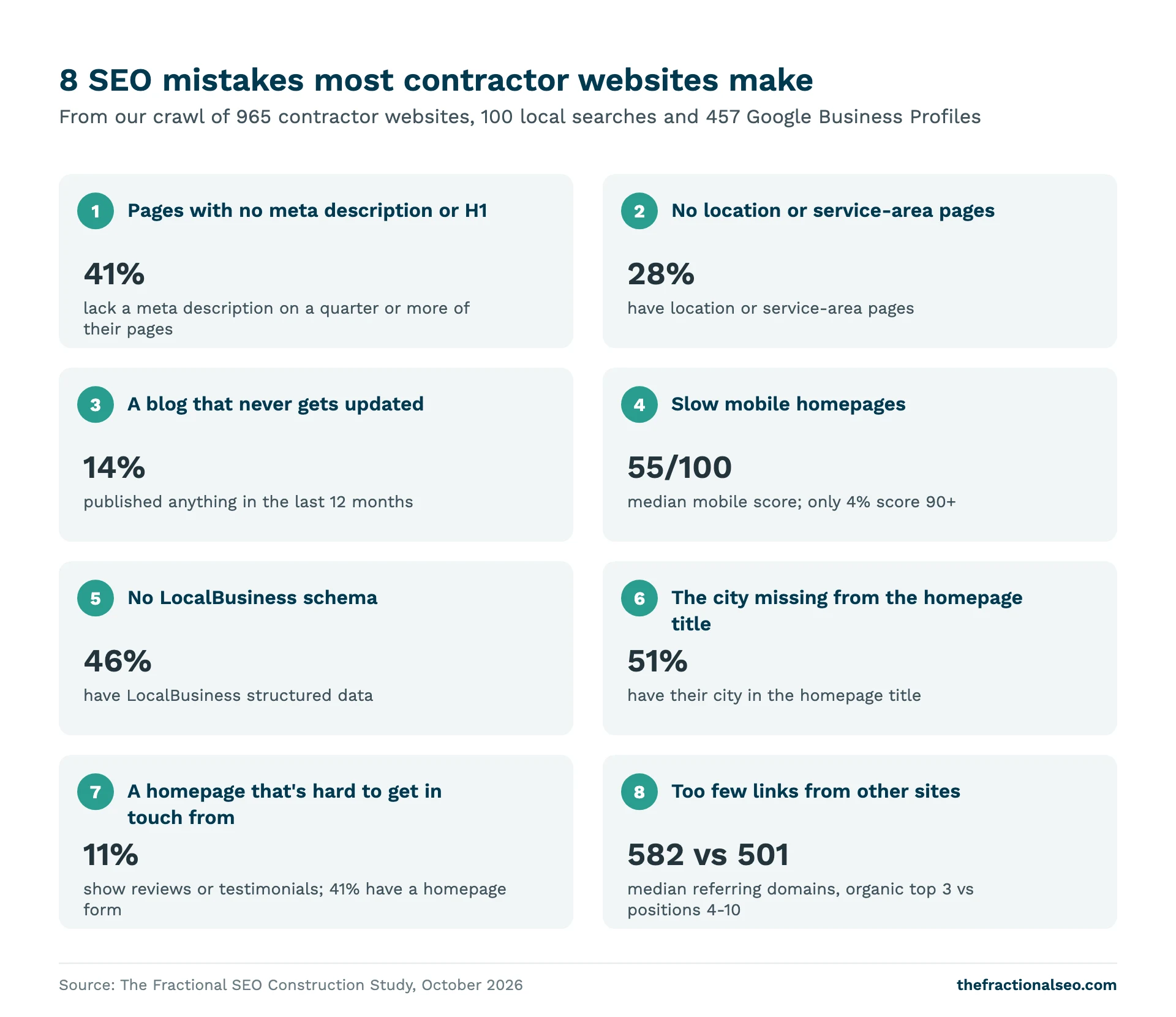
This is the most common gap in the study. 41% of sites lack a meta description on a quarter or more of their pages, 23% lack an H1 on a quarter or more, and 8% duplicate titles on a quarter or more. We measured this across 955 sites, counting only pages that Google can index.
The meta description is the short summary under your page title in search results. Google writes its own snippet from the page much of the time, but Google’s documentation says it sometimes uses the meta description if it gives searchers a more accurate summary. Leave it blank and you have handed the pitch for that page to whatever text Google pulls out. On a project page, that might be a photo caption.
The H1 is the main heading on the page. It tells a visitor, and Google, what the page is about in one line: “Kitchen remodeling in Plano”, not “Welcome”. A page with no H1 is usually a page where the topic was never decided.
Duplicate titles are the rarest of the three, but they cause the most confusion. When five pages share the title “Services | Smith Construction”, Google has to guess which one to show.
To find your own gaps, run a crawler such as Screaming Frog (free up to 500 URLs) over your site. Filter for missing meta descriptions, missing H1s and duplicate titles. Fix the pages that matter for money first: the homepage, each service page, each location page. Gallery and tag pages can wait.
Mistake 2: No location or service-area pages
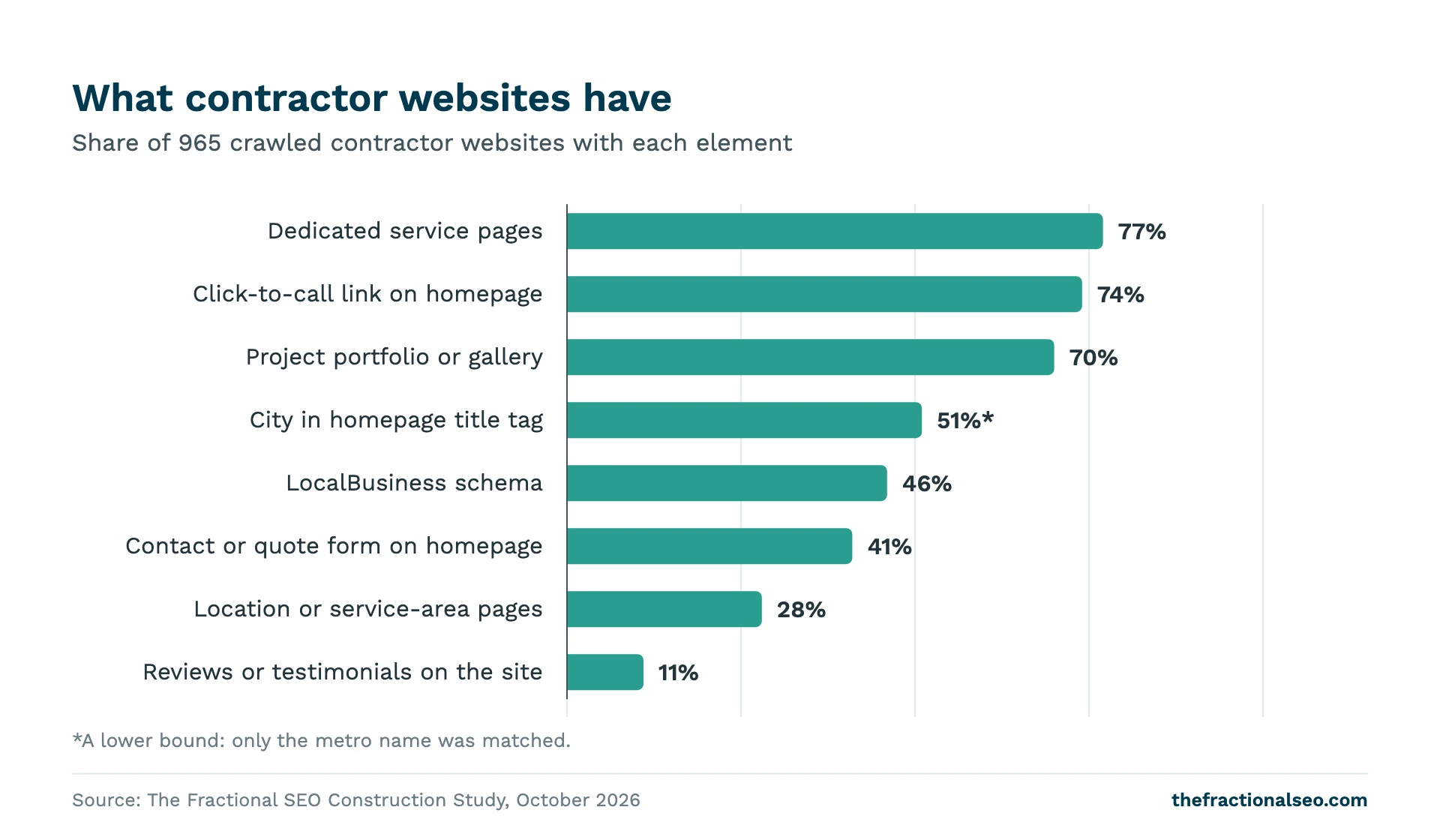
28% of contractor websites have location or service-area pages. Among the sites that do have them, the median is 5.
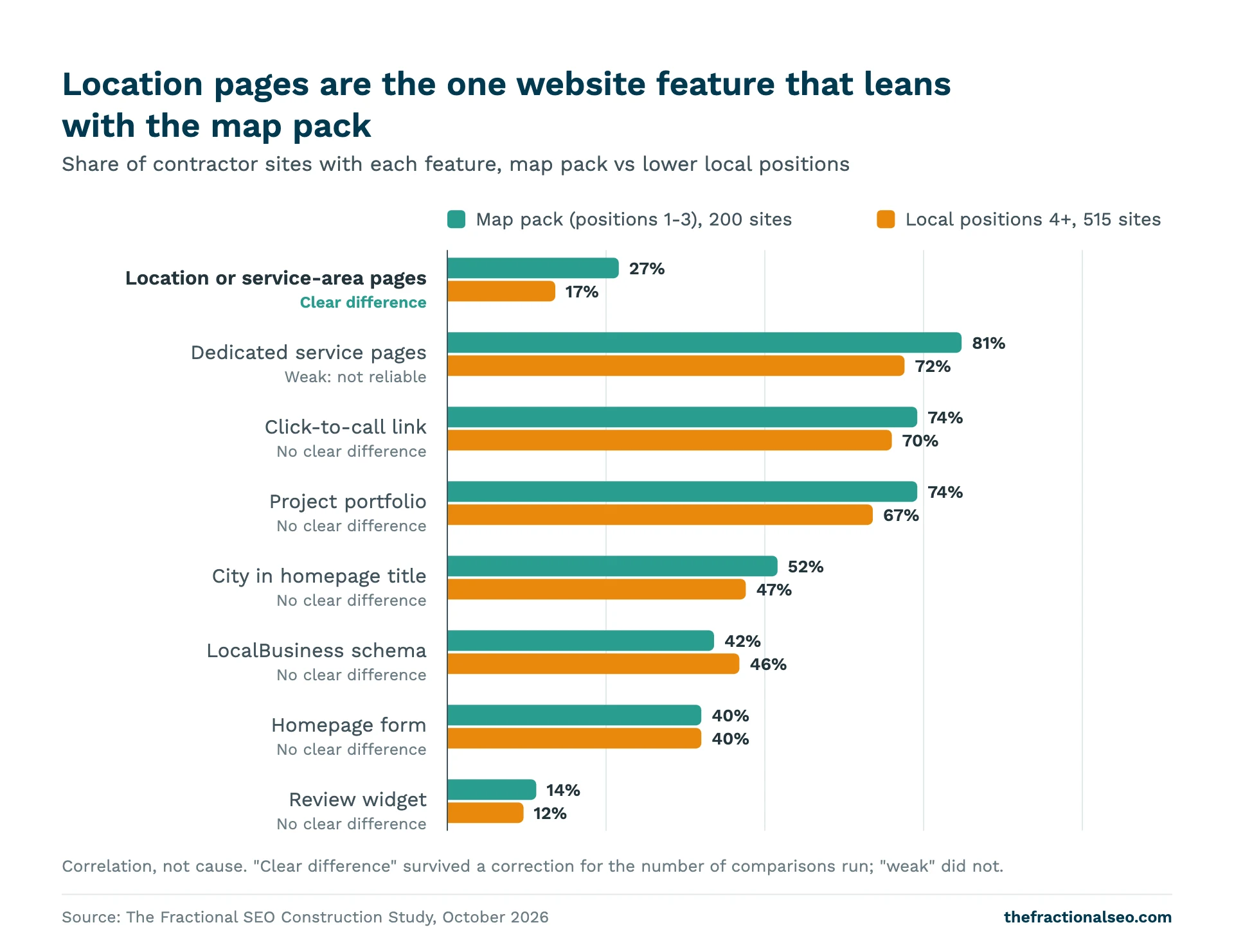
This is the mistake we’d fix first, because it’s the one website feature in the study that clearly leans with rankings. Contractors in the map pack are more likely to have location or service-area pages: 27% of map-pack sites vs 17% of sites at local positions 4+. We ran 18 comparisons between top-ranked and lower-ranked sites. This was the only one that held up after correcting for the number of tests.
Read that carefully. It’s a correlation, not proof that location pages put anyone in the map pack. Contractors who build out a page for each town they serve may also be the ones who’ve been in business longer, collect more reviews and run a tighter Google Business Profile. And even in the map pack, sites with location pages are a minority. Plenty of contractors rank without them.
But it’s the clearest website signal we found, and it makes sense. A remodeler based in one suburb who works across six has no page telling Google, or a homeowner, that they do work in the other five. A location page that shows real projects in that town, with photos, the local permit process and a review from a client there, answers that question.
The trap is the cheap version: one template with the city name swapped in, copied 40 times. Google’s spam policies list pages targeted at specific regions or cities that funnel users to one page as an example of doorway abuse. Five good pages beat 40 thin ones.
We detected location pages by URL pattern, and that method agreed with a hand-check 78% of the time, so treat the exact shares as close rather than exact. For the full breakdown, see Do Contractors Need Location Pages?
Mistake 3: A blog that never gets updated
50% of contractor sites have a blog, but only 14% published anything in the last 12 months and 6% averaged one post a month. The 14% and 6% are shares of the 798 sites where we could date the posts.
So “having a blog” and “running a blog” are different things. A blog whose newest post is from 2021 tells a visitor, who is about to trust you with a six-figure project, that nobody is minding the site.
Does blogging help rankings? The study can’t say much. Sites in the organic top 3 were somewhat more likely to have a blog than sites at positions 4-10, but that result was weak once we corrected for the number of tests, and in the map pack there was no difference. Having a blog is not the same as posting, and our ranking comparison only measured having one.
What we’d do: if you can’t post at least once a month, don’t put “Blog” in the main menu. Put the effort into project write-ups instead. A finished project with photos, scope, timeline and the town it was in is content a homeowner reads, and it can feed your location pages too. If you do want to post regularly, plan topics around the questions customers ask on sales calls.
Mistake 4: Slow mobile homepages
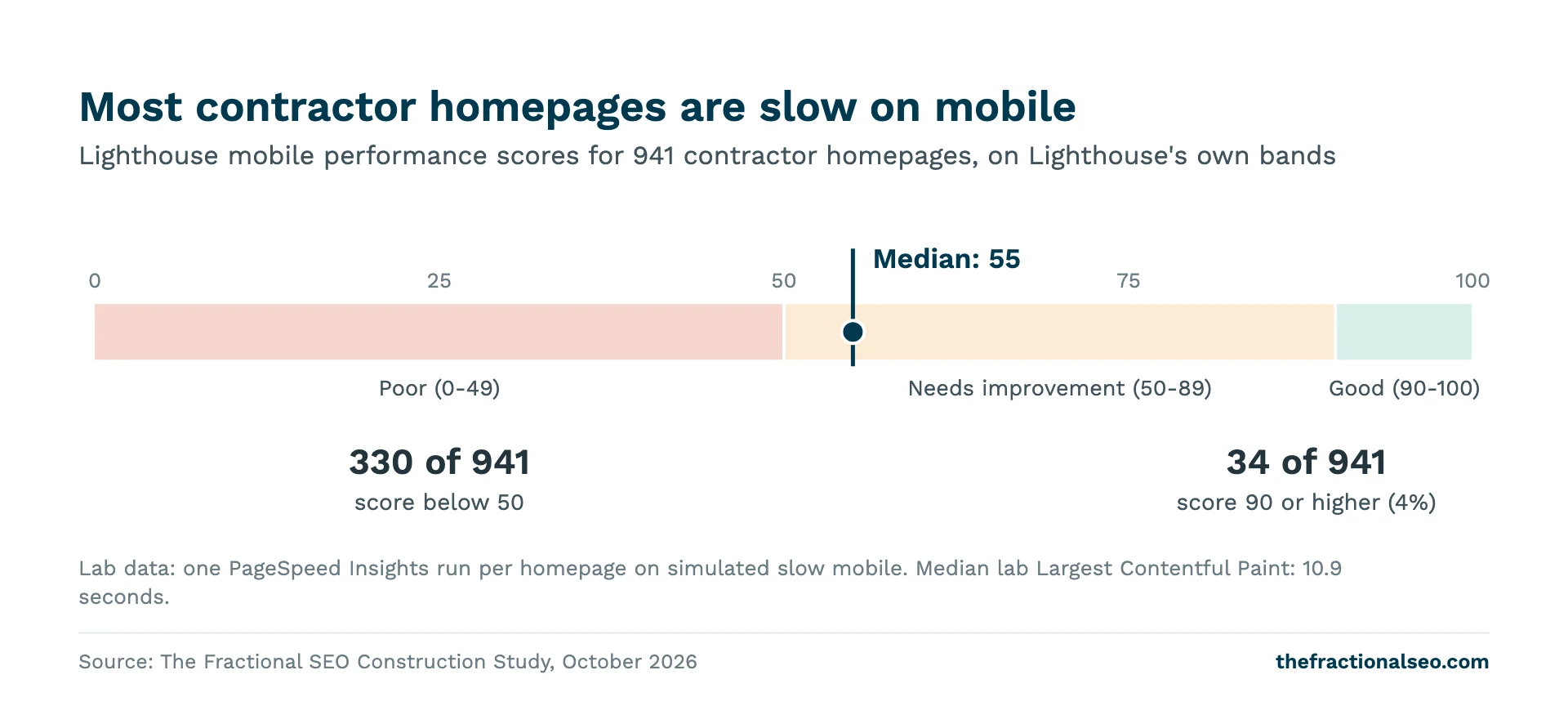
Contractor homepages are slow on mobile: median Lighthouse performance score 55/100, median lab Largest Contentful Paint 10.9s (simulated slow mobile); only 4% score 90+. We tested 941 homepages with Google’s PageSpeed Insights.
Two kinds of speed data matter here. Lab data is a test run on a simulated phone and slow connection. It’s repeatable and good for finding problems, but it isn’t what real visitors experienced. Field data, Google’s Core Web Vitals, comes from real Chrome users visiting your site, and it’s what Google uses in its page experience signals.
Here’s the catch for contractors. Most contractor sites get too little traffic for Google to report real-user speed data: only 16% have Core Web Vitals data, and 53% of those pass. For most contractors, lab scores are the only speed number available. Lab scores vary from run to run, so test two or three times before you act on one result.
Largest Contentful Paint is the time until the biggest thing on screen, usually the hero image, has loaded. On contractor sites that is very often a full-width photo of a finished kitchen or a job site, uploaded straight from a camera. The median homepage weighs 4.1 MB, and 41% are over 5 MB. Compressing and resizing that one hero image, and serving it as WebP, is often the single biggest fix.
Then look at what else loads on the homepage: sliders, video backgrounds, chat widgets and tracking scripts from tools nobody uses any more. Each one costs time on a phone. Our technical SEO basics for construction guide walks through the fixes in order.
Mistake 5: No LocalBusiness schema
46% of contractor websites have LocalBusiness structured data.
Structured data is code in the page that states facts in a format machines read without guessing: your business name, address, phone number, hours and service area. Google documents LocalBusiness markup and uses it to understand who you are and where you work.
In our ranking comparison, LocalBusiness schema showed no measurable edge. Top-ranked contractors had it at about the same rate as lower-ranked ones. So don’t expect adding it to move you up the map pack.
We still count it as a mistake to skip, for two reasons. It takes an hour, once, and most SEO plugins for WordPress will add it. And it keeps your name, address and phone number consistent in a form Google can check against your Business Profile. Make sure the details in the markup match the profile exactly, down to the suite number.
Mistake 6: The city missing from the homepage title
51% of contractor websites have their city in the homepage title tag. That figure is a lower bound: we matched the metro name only, so a title that names a suburb instead of the main city counted as missing.
The title tag is the blue headline in search results and the text on the browser tab. For a local contractor, the homepage title should say what you do and where: “General Contractor in Raleigh, NC | Company Name”. A title that says only the company name, or “Home”, tells a searcher nothing about where you work.
Like schema, the city in the title showed no measurable ranking edge in our comparison. Top-ranked contractors had it at about the same rate as everyone else. But the title is the first thing a searcher reads. A homeowner scanning ten results for “home builder Denver” is more likely to click the one that says Denver. It costs nothing to fix.
If you serve several towns, don’t stuff them all into the homepage title. Name the main city there and give the other towns their own location pages, each with its own title.
Mistake 7: A homepage that makes it hard to get in touch
This is where most contractor websites lose money, even though it isn’t an SEO problem in the strict sense. 74% of contractor websites have a click-to-call phone link on the homepage. 41% have a contact or quote form on the homepage. And only 11% have reviews or testimonials embedded on the site.
None of these showed a ranking edge. Click-to-call links, homepage forms, review widgets, portfolios, LocalBusiness schema and a city in the title tag show no measurable ranking edge: top-ranked contractors have them at about the same rate as lower-ranked ones. Treat them as conversion basics, not ranking levers.
That’s the point. SEO brings the visit; the homepage decides whether it becomes a call. A site that ranks well and makes contact hard is paying for traffic it then throws away. The fixes:
- Make the phone number a tap-to-call link in the header on every page.
- Put a short quote form on the homepage: name, phone, email, project type, town. Five fields, not fifteen.
- Show real reviews from real clients, with the project type and town where you can. Pull them from your Google Business Profile with the client’s permission.
More on this in how to generate construction leads with SEO.
Mistake 8: Too few links from other sites
Contractor sites in the organic top 3 have more referring domains than those at positions 4-10 (median 582 vs 501) and a higher Authority Score (23 vs 19). Referring domains are the number of different websites that link to yours. Authority Score is Semrush’s 0-100 score for a domain’s overall strength.
This was a strong result in the study, and it matches how Google has worked for a long time: links from other sites still count as votes. It’s still a correlation. Older, larger contractors tend to have more links and more of everything else.
The links that matter for a contractor are rarely the ones sold in bulk. They come from suppliers and manufacturers who list approved installers, trade associations and chambers you belong to, local news coverage of a project, subcontractors and architects you work with, and sponsorships in the towns you serve. Our guide to building backlinks for a construction business covers where to find them.
Which of these mistakes actually cost rankings?
Here is what the comparison showed. We split contractor sites into top-ranked and lower-ranked, two ways: map pack (positions 1-3 vs 4 and below) and organic (top 3 vs positions 4-10). Then we compared how often each group had each website feature. That’s 18 tests.
When you run 18 tests, one or two will look meaningful by chance. So we applied a correction for the number of tests. Only one result survived it: location pages in the map pack, 27% vs 17%.
Two others looked promising before the correction and are best read as weak:
- Map-pack contractors are a little more likely to have dedicated service pages (81% vs 72%), but the gap is weak once you account for the number of comparisons run.
- Sites in the organic top 3 are somewhat more likely to have a blog (67% vs 56% at positions 4-10), a weak result; in the map pack there is no difference (51% vs 45%).
Everything else, from click-to-call links to schema, came out about even. No difference found is not proof of no effect. A sample of a few hundred sites can miss a small edge. But it does mean none of these features is a strong separator for contractors.
Off the website, two things leaned clearly with higher rankings in the study. One was links, covered in Mistake 8. The other was Google reviews: map-pack businesses have more reviews, a median of 49.5 for positions 1-3 vs 36 for positions 4-7. See how many Google reviews a contractor needs for the benchmarks by contractor type.
So the order we’d work in: location pages, reviews and links for rankings, with the on-page basics fixed alongside because they are quick and help searchers. Then the homepage contact basics, because they turn the traffic you already get into calls.
What contractors already get right
It isn’t all gaps. 70% of contractor websites have a project portfolio or gallery, and 77% have dedicated service pages, with a median of 8 among those that have them. Nearly all contractor sites use HTTPS (963 of 965).
The portfolio is the asset most contractors underuse. A gallery of 60 photos with no captions does little for search. The same projects written up with the scope, the town and a few sentences on the problem you solved become pages that can rank, support your location pages and give a homeowner a reason to call. Service pages work the same way: one page per service you want to be hired for, written for the person who would hire you.
How to check your own site in 30 minutes
You don’t need an agency to find most of these. Set aside half an hour.
- Minutes 1-10, crawl. Run Screaming Frog (free up to 500 URLs) over your site. Export pages with no meta description, no H1 and duplicate titles. That is Mistake 1.
- Minutes 10-15, speed. Run your homepage through PageSpeed Insights on mobile, twice. Note the performance score and Largest Contentful Paint. Check whether a “Core Web Vitals” section with real-user data appears at all. That is Mistake 4.
- Minutes 15-20, the homepage. Read your homepage title in the browser tab. Is your city in it? On your phone, can you tap the number, find a quote form and see a review without scrolling far? That is Mistakes 6 and 7.
- Minutes 20-25, structure. List the towns you want work in. Count how many have their own page. Check whether your newest blog post is under a year old. That is Mistakes 2 and 3.
- Minutes 25-30, schema and links. Paste your homepage into Google’s Rich Results Test and look for LocalBusiness markup. If you have a Semrush or Ahrefs account, note your referring domains. That is Mistakes 5 and 8.
For a fuller pass, our local SEO checklist for construction companies turns this into a list you can work through. To see how your market’s page one splits between contractors and directories, read the local construction search benchmark.
When you’ve run the check and want help fixing what it found, talk to The Fractional SEO about construction SEO.
FAQs
What are the most common SEO mistakes on construction websites?
Missing on-page basics top the list: 41% of sites lack a meta description on a quarter or more of their pages, and 23% lack an H1 on a quarter or more. Only 28% have location or service-area pages, and only 14% of sites with a dated blog published anything in the last 12 months.
Do construction websites need a blog to rank?
Not on our evidence. Organic top-3 sites were somewhat more likely to have a blog, but the result was weak, and the map pack showed no difference. Regular project write-ups are a better use of the time for most contractors.
How fast should a contractor website load?
Faster than most do. The median contractor homepage scores 55/100 on mobile in Lighthouse, and only 4% score 90+. Aim to get your hero image loading quickly and test with PageSpeed Insights on mobile.
Does schema help contractors rank?
LocalBusiness schema showed no measurable ranking edge in our comparison. 46% of contractor sites have it. It’s still worth adding because it’s quick and keeps your business details consistent.
How many construction websites have location pages?
28% of the 965 contractor websites we crawled have location or service-area pages. Among those that do, the median is 5 pages.
More research & benchmarks
The whole Construction library- Who Wins Local Construction Searches in 2026: A Benchmark of 100 Searches Who holds page one and the map pack for local construction searches, by contractor type, across…
- How Many Google Reviews Does a Contractor Need to Make the Map Pack? Review benchmarks from 300 map-pack listings, by contractor type and market size, and how to set…
- Do Contractors Need Location Pages? What 965 Contractor Websites Show Only 28% of contractor sites have location pages, yet they were the one website feature that…