
Guide Construction
A Beginner’s Guide to SEO for General Contractors
Search "general contractor" plus your city and count the results that belong to an actual contractor. In our study, it was half. Contractor websites held 50% of page-one results on general contractor searches, the lowest share of the four contractor types we checked (remodelers got 56%, home builders 60%, commercial contractors 62%). The rest went to directories, social sites, news, associations and the like. We analyzed 100 local searches across 25 US metros and four contractor types, 1,034 contractor websites (965 crawled) and 457 Google Business Profiles, October 2026.
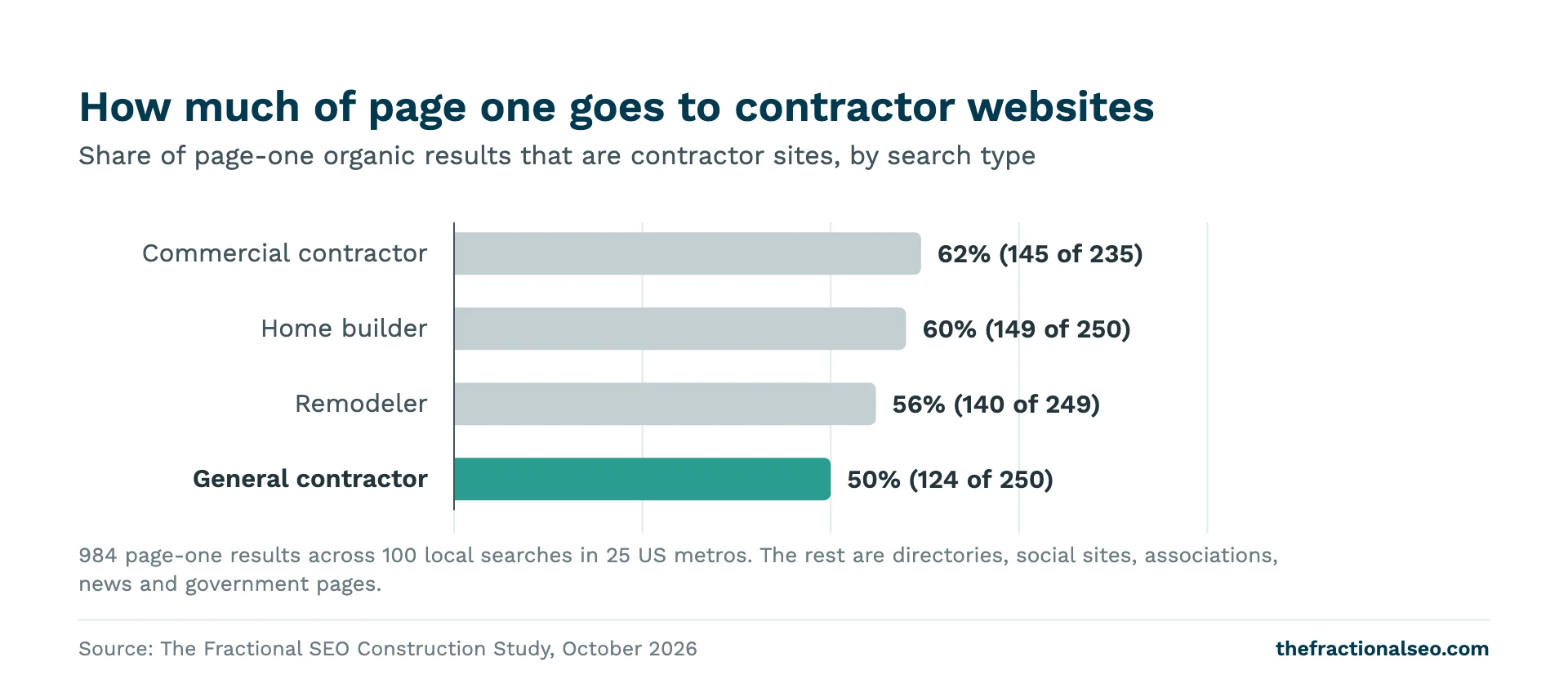
That doesn’t mean SEO is a waste of time for a GC. It means the job is different from what most “SEO for contractors” guides describe. Before you write a single blog post, you need to show up in the map pack, show up on the directories that rank in your market, and give Google a website with a page for each thing you build. This guide walks through that order, step by step, with the numbers behind each step.
The short version
- Two places to rank: the map pack (driven by your Google Business Profile) and the organic results below it (driven by your website). They are mostly different businesses.
- Start with your Business Profile: the right primary category, a real service area and a steady flow of reviews.
- Get listed where directories rank: on GC searches, half of page one isn’t a contractor. Be on the sites that are.
- Build service and location pages before you think about a blog.
- Expect modest numbers: the median contractor site gets an estimated 507 organic visits a month.
What SEO means for a general contractor
SEO is the work of getting your business in front of people who search Google for what you do, without paying for each click. For a general contractor, that mostly means local searches: “general contractor Denver”, “construction companies near me”, “home addition contractor”. Someone types that, Google shows a page, and you either appear on it or you don’t.
On those searches, there are two places to appear. The first is the map pack: the box with a map and three businesses that sits near the top. What decides who shows up there is mostly your Google Business Profile, the free listing Google keeps for your company. The second is the organic results: the ten blue links below the map. What decides those is mostly your website: its pages, what they say, and who links to them.
Google spells out what drives the first one. Its help page on local ranking names three factors, relevance, distance and prominence, and says prominence is based partly on “how many websites link to your business and how many reviews you have” (Google Business Profile Help). The same page says there’s no way to pay for a better local ranking. So the map pack is earned with a complete profile, reviews and a website other sites point to.
Paid ads sit above both. They’re a separate budget and a separate decision. This guide is about the two places you don’t pay per click for.
How GC searches work: map pack, organic and directories
Across all four contractor types in our study, only 57% of page-one organic results for local construction searches went to contractor websites. The other 43% went to directories, social sites, news, government pages, trade associations and chambers of commerce. On general contractor searches specifically, contractor sites held 50%.
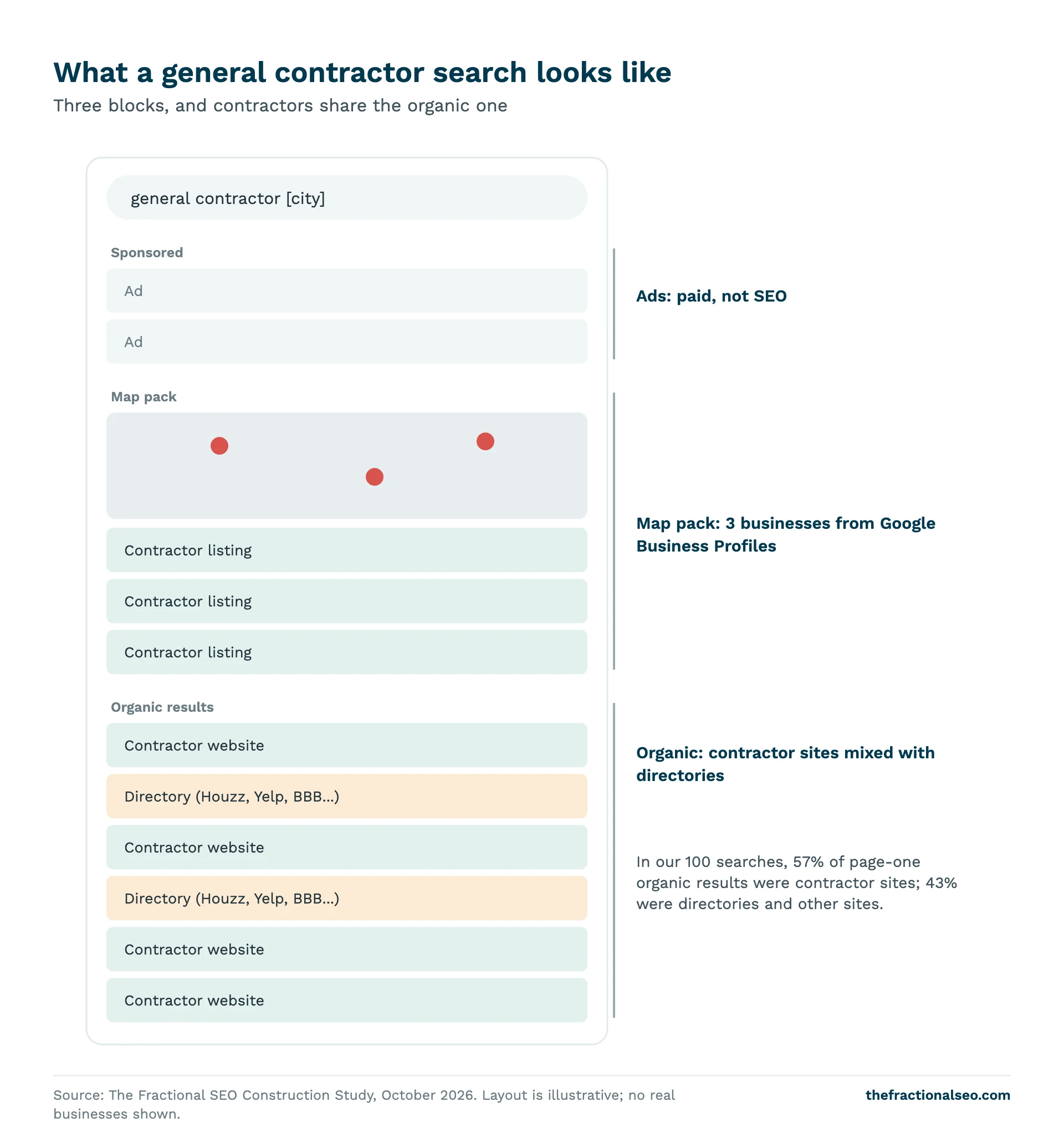
The second thing the data shows is that the map pack and the organic list are mostly different businesses. Only 29% of map-pack contractors with a website also ranked on page one organically for the same search. A contractor can sit in the top three on the map and nowhere in the blue links, or the other way round.
For a GC, that leads to three practical points:
- You have two separate jobs. Profile work moves the map pack. Website work moves organic. Doing one doesn’t do the other for you.
- You can’t win every organic spot. When Houzz, Yelp and BBB hold several page-one results, there are fewer left for contractors. Being listed on those sites puts you on page one by another route.
- Your website still matters to the map. Google’s own description of prominence includes links to your business, and those links point at your website.
Our local SEO guide for construction companies goes deeper on the map pack side. The rest of this guide is the beginner’s order of work.
What people search when they need a general contractor
Before you build pages, know the words. These are the highest-volume contractor searches in the US, from our keyword research in Semrush. Volumes are monthly national searches; your city will be a small slice of each.
| Search | US searches a month |
|---|---|
| general contractor | 49,500 |
| roofing contractors near me | 49,500 |
| concrete contractors near me | 33,100 |
| contractors near me | 33,100 |
| general contractors near me | 27,100 |
| construction companies near me | 27,100 |
Three things stand out. First, “near me” searches are big, and they are almost entirely map-pack searches. Google answers them by location, which is another reason the Business Profile comes first. Second, homeowners use “general contractor”, “contractor” and “construction company” loosely. Your pages should use the words your customers use, not only the term on your license. Third, trade searches like roofing and concrete are as big as the general ones. If you self-perform a trade, it deserves its own page.
Beyond these head terms sit the specific searches that turn into jobs: “home addition contractor”, “basement finishing”, “commercial tenant improvement”, each with a city attached. Make a list of the services you want more of and the towns you work in. Those two lists become your website’s structure in Step 3.
Step 1: Set up your Google Business Profile
If you do one thing from this guide, do this. The profile is free, it controls the map pack, and most of the work is a one-time setup.
Pick the right primary category
Google asks you to pick the primary category that best describes your business, to choose a specific one where it exists, and says the categories you select affect your local ranking. Among the map-pack contractors in our study, the most common primary categories were:
| Primary category | Map-pack contractors |
|---|---|
| General contractor | 99 |
| Construction company | 64 |
| Home builder | 36 |
| Custom home builder | 34 |
| Remodeler | 12 |
| Contractor | 8 |
If general contracting is what you sell, “General contractor” is the obvious primary category. Add a few secondary categories for real lines of business, such as “Remodeler” or “Construction company”. Google says not to add a category for every service, so keep it to the ones that describe whole parts of your business.
Set your service area honestly
Most GCs work at the customer’s site. Google says that if you don’t serve customers at your business address, you should remove the address and list a service area instead, by city or ZIP code, up to 20 areas. Be specific. Listing every town in a 100-mile radius doesn’t help a profile that is really known in three.
Fill in everything else
- Business name exactly as it appears on your signage and paperwork. No keywords stuffed in.
- Phone number and website, matching what’s on your site and your directory listings.
- Services, with a line on each. Use the same names as your service pages.
- Project photos from real jobs. Before-and-after sets work well for remodeling work.
- Hours, even if they’re “by appointment”.
Build a review habit
Reviews are the profile factor the data supports most clearly. Map-pack businesses had a median of 49.5 reviews against 36 for positions 4 to 7. That’s a correlation, not proof that reviews alone move you, but Google itself names review count as part of prominence. Google lets you ask customers for reviews with a link or QR code and strictly prohibits offering anything in exchange. The simplest habit: ask at handover, when the client is walking through the finished job, and send the link the same day. Our research piece on how many Google reviews a contractor needs to make the map pack breaks the numbers down by contractor type and market size.
For the full checklist, see the Google Business Profile guide for contractors.
Step 2: Get listed where the directories rank
On general contractor searches, the other half of page one is not empty space. It’s Houzz, Yelp, BBB, HomeAdvisor, Thumbtack and others. Across our 100 searches, houzz.com appeared on page one 66 times and yelp.com 65 times. No other directory came close; bbb.org was next with 17.
You can’t outrank those sites on every search, so be on them. A complete, claimed profile with real photos and reviews means that when a homeowner clicks Houzz instead of you, they can still find you. It also gives you a consistent listing of your name, address and phone number, which supports the same business details Google sees elsewhere.
Start with the free profiles. Paid upgrades are a separate decision with their own contracts. Our guide to Houzz, Yelp and BBB for contractors covers which directories suit which kind of GC and what to read before you pay for any of them.
Step 3: Build service and location pages
This is the core of your website for SEO. A one-page site with “We do it all” gives Google nothing to match a specific search to. A page per service, and a page per town you really serve, gives it something for each search.
Most contractors already do the first part. In our crawl, 77% of contractor websites had dedicated service pages, and the median among those that did was 8. Far fewer do the second: only 28% had location or service-area pages, with a median of 5 among those that had any.
Location pages are also the clearest website-side difference we found between map-pack contractors and the rest. Contractors in the map pack were more likely to have location or service-area pages: 27% of map-pack sites against 17% of sites at local positions 4 and below. That result held up after we corrected for the number of comparisons we ran. It’s still a correlation, and most map-pack contractors don’t have them, but it’s the strongest website signal in the study. Our research on whether contractors need location pages has the detail.
Service pages showed a weaker version of the same pattern. Map-pack contractors were a little more likely to have dedicated service pages (81% against 72%), but that gap doesn’t hold up once you account for how many comparisons were run. Treat service pages as a basic you need anyway, not a lever.
What a good GC service page has
- One service per page: “Home additions”, not “Additions, remodels and new builds”.
- What the job involves, start to finish, in plain words. Permits, timeline, who does what.
- Photos of jobs you completed, with a line on each.
- The towns you do this work in.
- A clear way to ask for a quote: a phone number that calls on tap and a short form.
What a good location page has
A location page earns its place when it says something true about that town: projects you’ve built there, the permit office you deal with, the kinds of homes or buildings in the area. Ten copies of one page with the city name swapped come close to what Google’s spam policies call doorway abuse: substantially similar pages targeted at specific cities. Start with the three to five towns where you most want work, and write each page properly.
Step 4: Fix the on-page basics
Every page needs a clear title tag, one H1 heading and a meta description. They’re quick to fix and often missing. In our crawl, 41% of sites lacked a meta description on a quarter or more of their pages, and 23% lacked an H1 on a quarter or more.
- Title tag: what the page is about and where. “Home Additions in Boise | Your Company”. Google asks for titles that are descriptive, concise and unique to each page, without keyword stuffing.
- H1: one per page, saying what the page is about. It can match the title closely.
- Meta description: a one- or two-sentence summary written for the searcher. Google says it builds snippets mainly from page content but may use your description when it describes the page better.
- City in the homepage title: 51% of contractor sites had their city in the homepage title tag. We found no ranking edge for it, but it tells a searcher at a glance that you work where they live.
For a page-by-page walkthrough, see on-page SEO for home builders and remodelers, which applies to GCs too. For speed, schema and the technical side, see technical SEO basics for construction.
Step 5: Earn links from local sources
Links from other websites are how Google judges whether a business is known. In our data, contractor sites in the organic top 3 had more referring domains than those at positions 4 to 10 (median 582 against 501) and a higher Authority Score (23 against 19). That’s a correlation: bigger, older firms tend to have more links and rank better for other reasons too. But it matches what Google says about prominence.
For a GC, the realistic link sources are local and trade ones:
- Directory and association listings (Houzz, BBB, your local home builders association, your chamber of commerce).
- Suppliers and manufacturers that list certified or preferred installers.
- Subcontractors and architects you work with regularly.
- Local news coverage of a notable project, a sponsorship or a community build.
Avoid anyone selling links in bulk. Our guide to building backlinks for a construction business covers each source and what to stay away from.
Step 6: Add content when the basics are done
A blog is the last step, not the first. The data on blogs is weak: sites in the organic top 3 were somewhat more likely to have a blog (67% against 56% at positions 4 to 10), but that result doesn’t survive correction for the number of comparisons, and in the map pack there was no difference (51% against 45%).
Having a blog is also not the same as using one. Half of contractor sites had a blog, but only 14% published anything in the last 12 months. An abandoned blog with three posts from 2019 says less about you than a good project gallery.
If you do write, write what clients ask you before they hire you: what a home addition costs in your area, how long permits take in your county, what to expect during a kitchen remodel. Those pages answer real searches and give other sites a reason to link to you.
What to expect: traffic and timelines
Set your expectations from real numbers. The median contractor website in our study got an estimated 507 organic visits a month, and 21% got fewer than 100. Those are Semrush estimates, modeled rather than measured, so use them as a rough guide. They also say something useful: a GC doesn’t need thousands of visits. A few of the right visits a week, from people in your service area who want an addition, can matter more than thousands from the wrong places.
On timing, the honest answer is months, not weeks. Ahrefs’ May 2025 study found that only 1.74% of pages in its sample reached Google’s top 10 within a year, though 40.82% of the pages that did get there made it within the first month. Profile fixes and new reviews tend to show up in the map pack sooner than new pages show up in organic results. Google’s own advice on hiring help is to ask what results to expect and in what timeframe, and to be wary of anyone who guarantees a ranking.
Measure leads, not just rankings. Calls from the profile, form fills and quote requests are what pay for the work. Our guide to generating construction leads with SEO covers the website side of that.
FAQs
Is SEO worth it for a general contractor?
For most GCs, yes, if you measure it in jobs rather than traffic. The median contractor site gets an estimated 507 organic visits a month, so the volume is modest, but these are people searching for exactly what you do, in your area. The Business Profile and directory work in Steps 1 and 2 costs little beyond time.
How long does SEO take for contractors?
Expect months. Profile changes and reviews can show up in the map pack within weeks; new pages usually take longer to rank organically. Our study didn’t measure timelines, so treat anyone who promises a date with caution.
What Google Business Profile category should a GC use?
“General contractor” if that’s your main line of work. It was the most common primary category among map-pack contractors in our study (99 of 264), ahead of “Construction company” (64). Add a few secondary categories for other real lines of business.
Do general contractors need a blog?
Not to start. The link between blogs and rankings in our data is weak, and only 14% of contractor sites published anything in the last year. Build your profile, directory listings and service pages first. Add articles when you have questions from clients worth answering.
Want a second opinion on your GC site?
We’ll look at your Business Profile, the directories that rank in your market and your service pages, and tell you what to fix first. Book a free general contractor SEO review.
For the full dataset behind this guide, see We Analyzed 965 Construction Websites.
Sources
- Google Business Profile Help, Tips to improve your local ranking on Google
- Google Business Profile Help, Choose a category for your Business Profile
- Google Business Profile Help, Manage your service area
- Google Business Profile Help, Tips to get more reviews
- Google Search Central, Influencing title links
- Google Search Central, Control your snippets in search results
- Google Search Central, Do you need an SEO?
- Google Search Central, Spam policies for Google web search
- Ahrefs, How long does it take to rank in Google (May 2025)
More guides
The whole Construction library- Technical SEO Basics for Construction Benchmarks from 965 contractor websites for speed, page weight, on-page gaps and schema, and the order…
- Houzz, Yelp and BBB: Why Directories Outrank Contractors, and How to Use Them Houzz and Yelp appeared on page one 66 and 65 times across 100 construction searches. Which…
- Mastering On-Page SEO for Home Builders and Remodelers A page-by-page on-page SEO guide for home builders and remodelers: titles, headings, service, community and portfolio…